- tyler@shipplate.com
- +86 15603721115
Steel is a common form of steel sheet pile because it offers good resistance to high driving stresses, excellent watertightness, and can be welded or bolted to increase length. They are connected by interlocking. There are four basic forms of steel sheet piles:
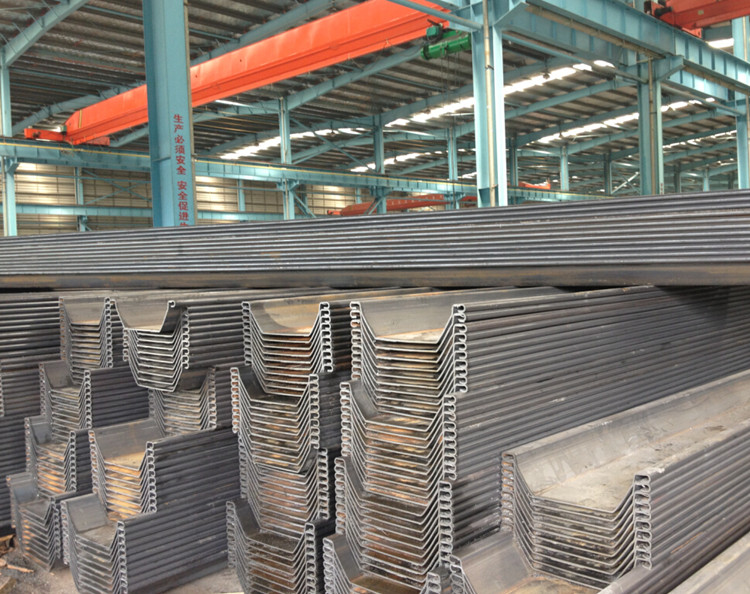
1. Normal Section
These include Larsen and Frodingham sheet piles, which are interlocking steel pile systems. They have good driving qualities and are designed to provide good strength for a low weight. The interlocking system facilitates easy pile positioning (pitching) and driving, and provides a tight-fitting joint to form an effective watertight seal. In some cases, a sealant can be brushed into the joints before pitching, causing it to expand in thickness to create a watertight joint. Larsen sheet piles are stronger and easier to drive due to their uniform cross-sectional shape. Frodingham sheet piles are typically interlocked in pairs, making them easier and faster to handle and pitch.
2. Straight Section
These are piles that interlock and are driven to form a honeycomb-like cofferdam, which may be filled with materials such as gravel and small rocks.
3. Box Sections
These are formed from two or more sheet pile sections welded together and are suitable when heavy loads and high bending moments are expected.
4. Composite Sections
These are typically used for seashore protection where large bending moments and heavy axial loads are expected. A typical composite pile is a double Fredingham section welded to the flange of a general-purpose I-beam.
