- tyler@shipplate.com
- +86 15603721115
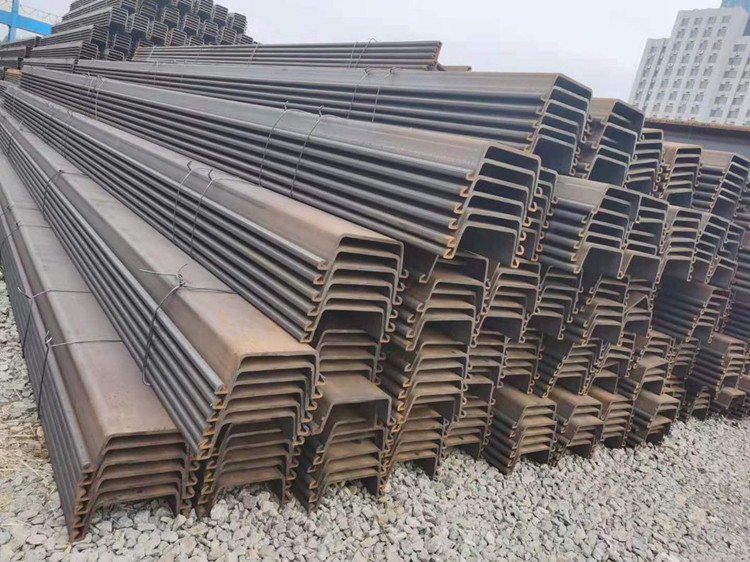
In recent years, they have been increasingly used in bridge pier cofferdam construction due to their advantages such as reusability, material savings, and cost savings. Traditionally, the first step in steel sheet pile construction is to insert the piles, then set up supports and pump out a layer of water. This construction process inevitably results in significant displacement of the steel sheet piles. The construction process for the steel sheet pile cofferdam at the central pier of the Jiaomen Waterway Bridge on the Guangzhou Panyu Huanglan Expressway differs significantly from traditional methods. In this project, a five-layer internal support frame system was welded and assembled above the water surface before being lowered to the designed location. The next step was to insert and drive the steel sheet piles, significantly reducing the time required for pumping out water and assembling the supports layer by layer. This reduced exposure time within the cofferdam and improved project safety. Furthermore, monitoring data analysis showed that this process can control deformation of the steel sheet piles, providing valuable insights for similar projects. The Jiaomen Channel Bridge on the Guangzhou Huanglin Expressway is 1,043 meters long and can be divided into a main bridge and an approach bridge. The main deck is arranged on two parallel bridges, with a total width of 40 meters. Each bridge is 19 meters wide. The bridge is designed with four central piers, with the main pier foundations constructed on elevated pile caps. These caps measure 17m x 10.5m and are 4.0m thick. They are 3.1m high at the top and 7.1m high at the bottom. According to the site geological survey report, the riverbed covers 12.5-7.0m of medium silt sand, 21.2-7.8m of silt sand, and 31.2-5.9m of silty clay. The average high tide level at Jiaomenkou is 6.2m, and the average low tide level is 4.3m. The lowest navigable water level at the bridge site is 3.79m, while the highest navigable water level is 7.3m. The four central piers are located in the Jiaomen channel. The main pier foundations consist of six Ø2.5 pile groups supporting massive concrete piles. The base of the cap is approximately 4.5m below the riverbed. This project utilizes a steel sheet pile cofferdam system, measuring 20.05m x 12.76m in plan, comprised of 24m-long Larsen steel sheet piles. The designed top elevation of the steel sheet piles was 7.3m. The initial water level at the construction site was 6.5m. The mud level was -2.7m. The first, second, and third beams were located at 6.0m, 3.0m, and ±0.0m, respectively. The fourth and fifth beams were located within the range of -2.0m to -4.0m.
During the traditional steel sheet pile cofferdam construction process, the working platform and guide casings were first arranged. Then, the steel sheet piles were driven. The support and pumping procedures were followed until the water was completely pumped out. The steel sheet piles experienced absolute displacement during the placement of each support, with greater displacement occurring after the final pumping. The depth from the first beam to the bottom of the cofferdam in this project was 13.6m. Under traditional construction procedures, six layers of support were required, with relatively small vertical spacing between each layer. This would have been inconvenient for construction. Furthermore, setting up six layers of support was time-consuming, and pumping out water from the foundation pit always carries a high risk. To shorten construction time and reduce construction risks, this project broke with traditional construction procedures. First, the internal support frame system was deployed above the water surface and then lowered to the designed position. The next step in this plan was to insert and drive the steel sheet piles. This improved construction technique required only five layers of internal support to meet safety requirements. After the five layers of support frames were secured, the water was pumped out of the cofferdam. Compared to traditional construction procedures, displacement during pumping was significantly reduced, facilitating control of the total displacement of the steel sheet piles. Furthermore, the construction process employed a single pumping-to-bottom method. This method reduced pumping time to approximately five days. Afterwards, concrete was poured into the cofferdam and capping, significantly reducing exposure time within the cofferdam. In this project, four steel jackets at each corner of the cofferdam served as the load-bearing structure. These jackets were inserted into supports 0.5 meters above the water surface, setting up a working platform. The fifth mid-beam was then suspended from the top of the jacks via the completed deformable rods. 2-meter-high columns were then welded to the fifth mid-beam, followed by the fourth and third mid-beams. Afterwards, the supports could be removed. Using four jackets, the three-layer internal support system was lowered to 0.5m above the water surface. The next step was to set up the second and first layers of the internal support system and lower them. The vertical spacing between the five layers was 3m, 3m, 2m, and 2m, respectively. Once all five layers had been lowered to their designed positions, the support system was positioned.
