- tyler@shipplate.com
- +86 15603721115
Steel sheet piles are designed to interlock with each other. They are installed sequentially along the perimeter of the planned excavation. When arranged together, they form a wall for permanent or temporary earth support and an anchor for additional lateral support. Let's discuss how steel sheet piles are driven.
When driving steel sheet piles, driving must be carefully monitored. If a pile no longer penetrates the soil, it should be stopped immediately before moving on to the next pile. In some cases, several adjacent piles will not penetrate to the designed depth. In this case, efforts should be made to clear the obstruction by partial excavation or the use of water jets. There is an acceptable number of "underdriven" sheet piles, but this varies depending on the specific design requirements. Guide controls should be used to address this issue.
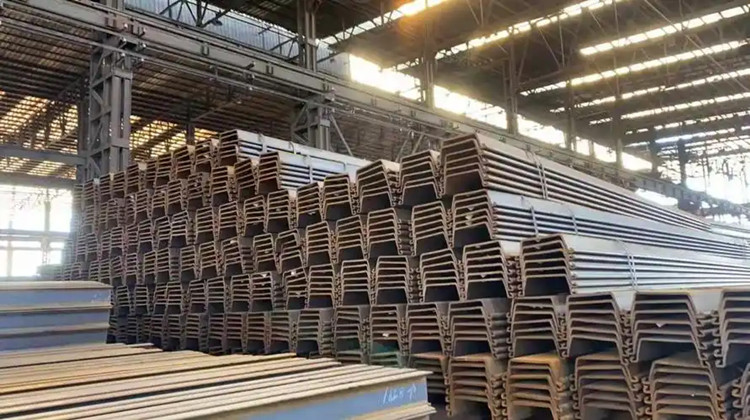
One technique is panel driving. This involves dropping and driving two piles at either end of a group of piles to partially or fully penetrate. The panel is then supported by "bookend" piles during driving to its final position. The pair remaining at the end then forms support for the next panel.
Another technique uses trestles and fences to support and position the sheet piles during driving. Vibratory hammers are commonly used to install sheet piles, but if the soil is too hard or dense, an impact hammer can be used.
In some locations where vibration is a concern, the sheet piles can be driven into the ground hydraulically. The sequence is as follows:
1. In-situ soil is placed behind the proposed structure.
2. The sheet piles are driven in.
3. The anchor level is backfilled and the anchor system is placed. Backfill is then applied to the wall.
4. The front face of the wall is excavated.
