- tyler@shipplate.com
- +86 15603721115
Currently, research on the characteristics of Larssen steel sheet pile support is insufficiently in-depth. Traditional methods, such as the equivalent beam method and the flexible support method, primarily use two-dimensional methods for support calculations. These methods ignore stiffness changes and spatial effects, and fail to effectively calculate surrounding soil deformation. Therefore, accurately determining the horizontal spacing of Larssen steel sheet pile lateral supports is crucial for minimizing the impact of construction on the soil and improving construction efficiency.
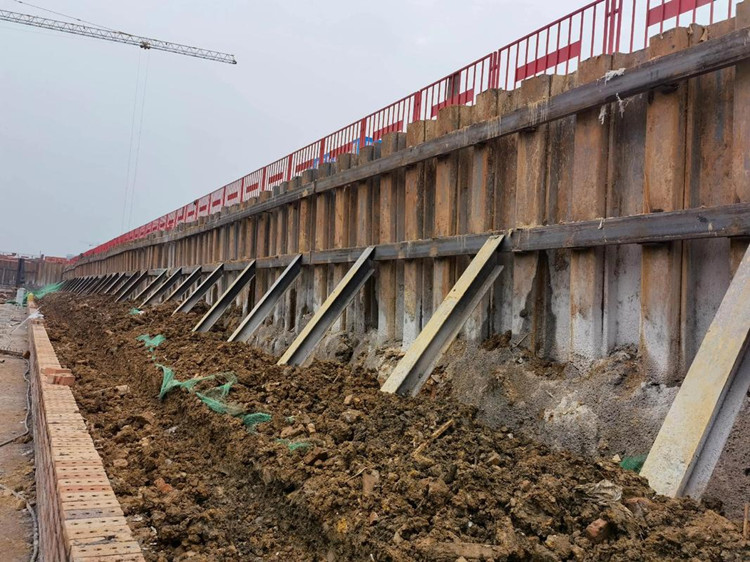
After excavation, deformation at the lateral supports was minimal, measuring 2.5 cm. Deformation of the Larssen steel sheet piles near the center of the lateral supports was greater, measuring approximately 3 cm, an increase of approximately 20%. This is because the Larssen sheet piles become weaker at the lateral supports as they get farther away, causing the deformation to gradually increase. Furthermore, due to the large overall thickness of the structure, the overall flexural stiffness is low. Furthermore, the reinforcement lap joints do not bear the bending moment, resulting in a significant change in the lateral support stiffness. Consequently, the deformation of the Larssen sheet piles in the middle of the cross brace increases significantly.
Due to the significant variation in the lateral support stiffness of the Larssen sheet piles, the lateral deflection of the sand exhibited a pronounced wave-like distribution along the pit edge, with a maximum value of 2.9 cm. The highest settlement of the soil near the pit edge occurred midway between the adjacent lateral supports, reaching a maximum of 0.9 cm, far below the standard's control requirement of no more than 3 cm. The plastic deformation zone of the sand exhibited a distribution similar to that of the row pile support structure, forming a jagged pattern extending from both sides of the piles toward the outside of the pit. A small portion of the sand between the piles exhibited no plastic deformation. The plastic deformation zone extended within approximately 0.5 m of the pit edge, a relatively small range. The overall reliability index, derived using the finite element analysis strength reduction method, was 1.67, meeting the standard's reliability requirement of over 1.2. Therefore, this support design offers increased safety for pipe pit excavations in relatively favorable geological conditions.
In summary, the lateral support bending stiffness of Larssen steel sheet piles varies greatly. Its support characteristics have both the overall stress characteristics of the connected wall and the support characteristics of the pile row structure. Its support characteristics are close to the middle between the pile row support and the ground connected wall.
