- tyler@shipplate.com
- +86 15603721115
With the rapid development of communications in China, the density of the highway network continues to increase. Long-span bridges are constantly emerging, especially in the Jiangsu and Zhejiang regions, which are the most urbanized regions in China. This region is also characterized by the abundance of rivers and lakes. Many highways require bridges with high navigable heights and long spans to cross waterways. For most bridges, a concrete cap is constructed on top of the pile foundation, but in these cases, the cap is often underwater. This means that conventional dry construction methods are ineffective. Effective measures are being taken to provide conditions for dry construction and ensure project quality. Therefore, steel sheet pile cofferdams are widely used in bridge foundation construction. Dry construction conditions are achieved by inserting steel sheet piles into the riverbed to form a retaining structure. Steel sheet pile cofferdams can come in many sizes, including small rectangular, square, circular, and flat.
Design Requirements for Steel Sheet Pile Cofferdams
1. Selection of Steel Sheet Piles
In China, SP-IV or SP-V steel sheet piles are two typical lengths of steel sheet piles. The specific length of these steel sheet piles is determined by the geological conditions and water depth of the construction area. The base elevation of standard steel sheet piles is 6 to 10 meters above or below the bed elevation. The highest water level is 0.5 to 1 meter higher than the highest water level during construction.
2. Design of Steel Sheet Pile Cofferdam Plan Dimensions
The plan dimensions of the steel sheet pile raft are determined by the size of the abutment and are generally 1.5 to 2.0 meters larger than the pile perimeter. The modulus of the steel sheet piles is another factor that needs to be considered.
3. Design of Internal Support for the Steel Sheet Pile Cofferdam
After the steel sheet piles form the retaining structure, the cofferdam must be drained and some soil removed. Due to the pumping, the water levels inside and outside the cofferdam differ, exerting significant pressure on the steel sheet piles. In this situation, supporting the steel sheet piles to resist the lateral pressure of the water is the next step.
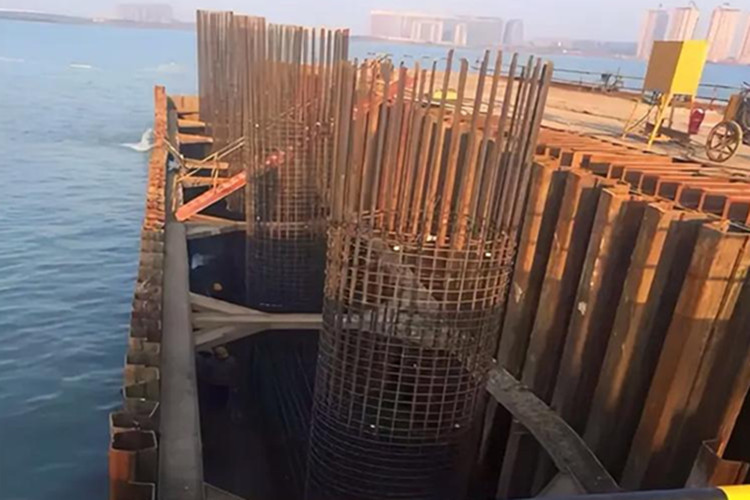
Construction Method
1. Steel Sheet Pile Preparation
Before the steel sheet piles are transported to the construction site, they require a detailed inspection. This is because they may be a mixture of new and old materials of unknown quality. During this verification process, it is recommended to use short piles of the same type to test the piles at both gates, each 2-3 meters long. It is recommended that two to three people pull the piles through the gates or use an elevator to pull them. If conditions permit, the use of an inspection trolley is recommended. If the lock cannot be passed through or exhibits other defects such as bending, twisting, or doglegs, the piles can be repaired through cold bending, hot hammering (temperatures not exceeding 800-1000°C), welding, riveting, cutting, and lengthening. For welding, butt welding is the first step, followed by welding reinforcement plates. Furthermore, long welds require active clamping to prevent deformation. For sheet pile locks,
2. Selection of Piling Machinery
The lifting equipment used to insert steel sheet piles is generally a floating crane or a pile hammer. If the project is entirely constructed above water, a floating crane is preferred. The crane's lifting angle, span, and lifting capacity are factors to consider before selecting a machine. A vibratory hammer with a corresponding hydraulic clamp is typically used as the pile driver. The size of the vibratory hammer is selected based on the geological conditions at the construction site.
3. Inserting Gauge Piles
In most cases, standard piles are inserted parallel to the cofferdam edge. Φ609 steel sheet piles are commonly used for these gauge piles, with steel sheet piles being the preferred choice. To ensure these piles are correctly positioned, a theodolite is the preferred instrument for inspection. Standard piles are typically 1 to 1.5 meters from the cofferdam edge, with a recommended spacing of 5 to 7 meters.
4. Installing the Launching Nose
Existing steel sheet piles can be used to set up the launching nose, which serves as an operating platform. The width of the launching nose is determined by the width of the cofferdam wall, with the gap in the center of the launching nose approximately 20 cm greater than the wall width.
5. Inserting the Steel Sheet Piles
First, mark the location of each steel sheet pile on the surface of the launching head. Then, starting from the center, insert the steel sheet piles in both directions. After one side of the steel sheet piles is installed, remove the launching nose. Repeat the same procedure for the rest of the cofferdam.
6. Pumping Out, Welding, and Supporting
After the cofferdam is closed, an inner ring support can be installed at the top of the piles, followed by pumping out the water. When the water level drops 1 meter below the support, pumping should be stopped. Another inner ring support should be installed, and pumping should be restarted. This process should be repeated until the sheet piles are fully supported.
7. Stop Leakage
Leaks typically occur at the lock joints of the old sheet piles. Yellow sand is a solution. Pouring it into the water until the pile covers the leak will resolve the problem.
8. Dismantling the Cofferdam
Once the pier cap is completed, the cofferdam can be dismantled. Before dismantling, the temporary joints inside and outside the cofferdam should be cleaned. The next step is to pump water into the cofferdam to approximately 1 meter below the lowest horizontal inner support and remove that support. Workers then continue to fill the next horizontal inner support with water and remove it, repeating this process until all supports have been removed. Furthermore, a vibratory hammer is used to pull up all the sheet piles.
Quality Control
1. To ensure successful pitching and ascension of the piles, the piles must be vertical, and the number of steel sheets should be evenly distributed around the cofferdam.
The first sheet pile must be completely vertical and perpendicular to the horizontal plane. Because the top and bottom widths of steel sheet piles are unequal, the piles are prone to tilting. In this situation, enhanced measurement work is necessary during construction. When tilt is detected, timely adjustments are required to ensure that the tilt of each set of steel sheet piles along the cofferdam's perimeter and vertical direction does not exceed 5%.
2. When using spliced steel sheet piles with long splicing lengths, the spliced steel sheet piles should not be on the same section of the cofferdam. Furthermore, the joints between adjacent piles should be staggered by at least 2m. Therefore, spliced steel sheet piles should be prepared in advance and stacked in the order of piling during transportation and storage.
3. When inserting and driving steel sheet piles, if the verticality of the steel sheet piles is good, they should be driven immediately to the desired depth. If the verticality is poor, the piles should be driven to the desired depth in two separate passes. In the second case, all piles should be driven to approximately half the depth, with the second pass forcing them to the desired depth.
4. During the use of the steel sheet pile cofferdam, workers must ensure that the water level inside the cofferdam is higher than the water level outside. The first step is to connect the pipeline at a low water level and close it when pumping water from the cofferdam. In addition, it is necessary to control the pumping progress. When the water level reaches the inner support of each layer, the inner support should be set in time.
