- tyler@shipplate.com
- +86 15603721115
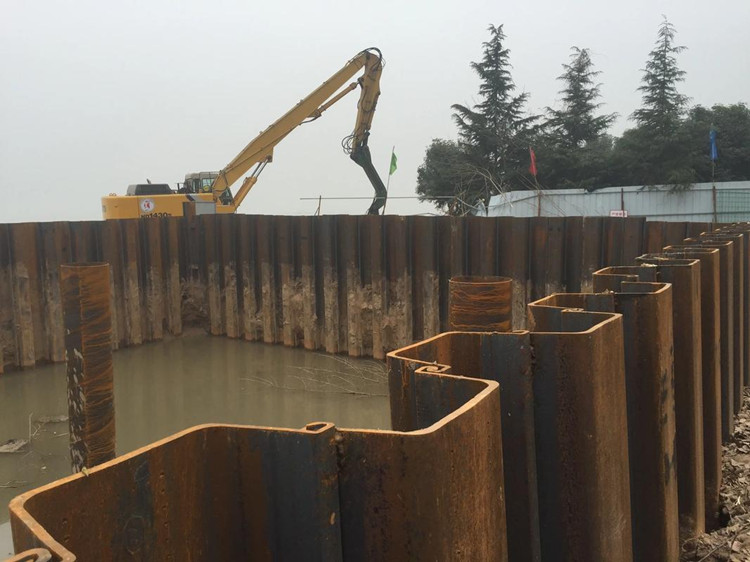
There is no single answer to how many steel sheet piles can be installed in a day, as installation efficiency varies significantly depending on soil conditions, pile dimensions, installation methods, and the metric used to measure progress (e.g., number of piles, linear length, or wall area).
The following are typical industry installation rates based on different measurement standards:
1. By number of piles
For standard projects, installation crews typically install between 4 and 20 piles per day.
1) Standard to deep piles: For projects with pile depths reaching 20 meters, installing 10 to 12 piles per day is considered achievable.
2) Large/heavy-duty piles: For large-section piles (such as the AZ-800 series), the average daily installation rate drops to approximately 4 to 8 piles. For ultra-heavy piles exceeding 28 meters in depth, it may only be possible to install 3 to 4 "king piles" per day.
3) Press-in method: When using the silent hydraulic static press-in method, specialized projects can expect to install approximately 20 sheet piles per 8-hour workday.
2. By linear length (LF)
When measuring the total continuous length of the wall, conservative benchmarks provided by state Departments of Transportation (DOTs) account for the time required for crane repositioning, pitching (lifting into position), and the actual driving process.
1) General estimate: The Florida Department of Transportation (FDOT) estimates the installation rate for temporary steel sheet pile walls to range from 150 to 500 linear feet per day.
2) High-precision walls: For projects requiring strict alignment and verticality of the exposed sheet piles, crews have achieved installation rates of approximately 150 linear feet per day.
3. By wall area (SF)
Measuring by the total surface area of the installed wall (length × depth) is another common estimation method. 1) Typical Benchmarks: The Wisconsin Department of Transportation (WisDOT) lists a typical installation rate for temporary steel sheet piles of 220 to 690 square feet per day, with 340 square feet serving as the standard average.
2) Depth Variations: The Michigan Department of Transportation (MDOT) estimates productivity at 485 to 560 square feet per day, adjusting these figures based on sheet pile depth (15, 20, or 25 feet).
Key Factors Affecting Installation Speed
4. These figures vary significantly, primarily due to the following key factors:
1) Soil Conditions: This is the most significant variable. In soft soils, driving speeds are extremely high, sometimes allowing for the installation of hundreds of square meters of sheet pile wall per workday. However, if crews encounter dense sand layers, cobbles, or rock, productivity drops sharply unless pre-drilling or high-pressure water jetting is used to assist installation.
2) Installation Method: The type of equipment used significantly alters installation speed. Driving sheet piles with a vibratory hammer is nearly twice as fast as using a conventional impact hammer. Impact hammers are slower and generate excessive noise, which can lead to restrictions on operating hours in urban environments.
3) Pile Size and Weight: Heavier and wider sheet piles require more time for rigging, positioning (lifting into place), and driving into the ground. Standard light-to-medium piles can be driven quickly, whereas heavy-duty piles require large cranes and take longer for each lift.
4) Site Logistics and Construction Tolerances: Open sites with easy access for trucks or barges facilitate a continuous workflow. In contrast, confined urban sites, over-water operations, or projects requiring extreme precision (such as interlocking sheet piles for watertight cofferdams) necessitate slower, more cautious operations to avoid damaging the interlocks and to ensure a perfect seal.
