- tyler@shipplate.com
- +86 15603721115
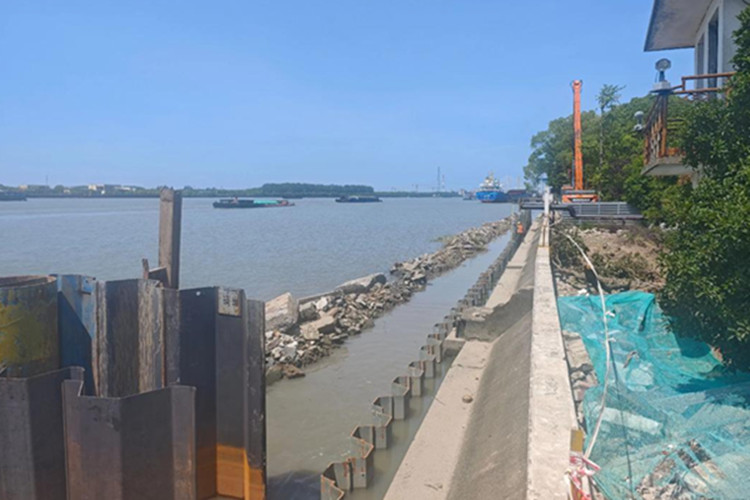
Steel sheet piles play a vital role in flood control projects, primarily used to construct flood walls and breakwaters. These structures withstand the impact of floods and waves, protecting coastal areas from natural disasters.
1. Core Advantages
1) Excellent Waterproofing Performance: Steel sheet piles have excellent waterproofing performance, high strength, and long service life, reaching up to 50 years.
2) Reusable: Reusable, saving costs and offering good economic benefits.
3) Rapid Construction: Simple structure, good flood control effect, and can be quickly deployed in flood control and disaster relief.
4) Stable and Reliable: Multiple steel sheet piles can be combined to form a flood wall to block floods. The combination of steel pipes and steel sheets allows for secure water blocking when driven into the soil.
2. Main Application Scenarios
1) Permanent Projects:
* Flood control dike construction
* Wharves and retaining walls
* Coastal protection projects
* Seepage-proof intercepting walls
2) Temporary Projects:
* Flood control and disaster relief
* Flood diversion
* Emergency flood control
3. Technical Characteristics
1) Flood Wall Structure:
* Single-layer steel sheet pile flood walls can be constructed by assembling multiple steel sheet piles together to form a flood wall, blocking floodwaters and achieving the purpose of water retention and flood control.
2) Dike reinforcement:
* Steel sheet piles can seal and stabilize existing and new flood control dikes, preventing tidal intrusion.
* Installing steel sheet pile anti-seepage walls inside dikes can increase overall stability, reduce permeability, and increase flood control height.
3) Water interception and seepage prevention:
* Steel sheet piles, as water interception walls, can block the flow of surface and groundwater.
* Typically, a depth of 10 feet (approximately 3 meters) of steel sheet piles is sufficient to cut off seepage.
4. Development of new materials
Plastic steel sheet piles:
1) A new type of flood control material that has emerged in recent years, made of high-density polyethylene (HDPE) or polyvinyl chloride (PVC) composite with steel.
2) Weighing only 1/5 of traditional concrete piles, they are easy to transport and construct.
3) Widely used in channel flood control and bank protection design.
5. Actual engineering cases
Thunder River flood control:
* The sheet piles are supported by 12m long 305×223HP load-bearing piles, located on the front side of the sheet pile wall with an inclination angle of 10 degrees.
* Concrete grout is injected between the sheet piles and the HP load-bearing piles to the excavation depth, forming a stable flood control structure.
6. Summary of Technical Advantages
The application of sheet piles in flood control projects has the following advantages:
1) Fast construction speed, suitable for emergency rescue
2) Good waterproof performance and significant seepage prevention effect
3) High structural strength, able to withstand flood impact
4) Reusable, economical and environmentally friendly
5) Strong adaptability, applicable to various terrain conditions
Sheet pile flood control technology has become an important means in modern flood control projects, playing an irreplaceable role in ensuring urban safety and protecting people's lives and property.
