- tyler@shipplate.com
- +86 15603721115
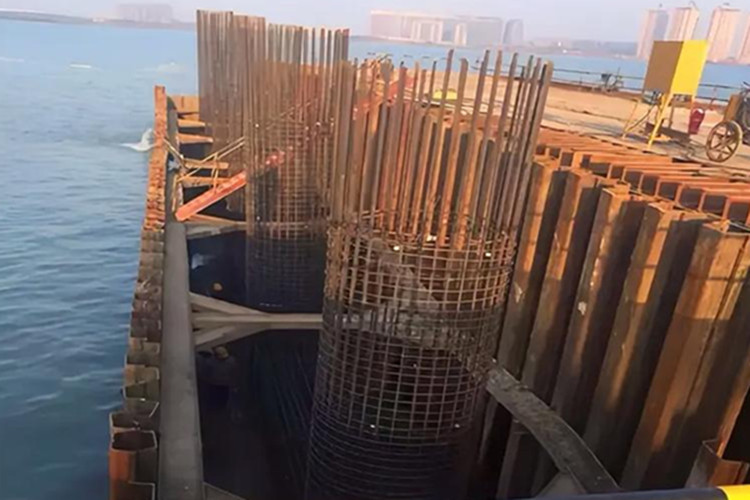
Steel sheet pile cofferdam construction is a very complex project. Today, let's discuss the precautions required.
1. Pre-construction Preparation
1) Material Inspection and Correction
* New and old steel sheet piles must be sorted and numbered, and the integrity of the interlocking joints must be inspected. Bent or severely corroded piles should be hydraulically straightened or fire-bathed.
* Extended steel sheet piles must be welded with reinforcement plates and subjected to interlocking joint tests to ensure watertight performance.
2) Guide Device Installation
Before construction, measurement observation points should be established upstream and downstream of the cofferdam and on both sides. Guide frames (such as steel corbel frames) should be installed to control verticality (deviation ≤ 0.5%).
3) Interlocking Joint Treatment
Apply grease or special water-stopping material to the interlocking joints to prevent leakage.
2. Pile Driving Process Control
1) Driving Sequence
Closing the cofferdam in stages from upstream to downstream is done, with the screen-type driving method (driving in batches, with a single driving depth of ≤3m) being preferred to minimize misalignment.
Use special-shaped piles or the axis-sealing method at corners to avoid welding deformation.
2) Verticality Monitoring
Verticality of the piles should be calibrated with a theodolite every 1m of driving. The first pile must be precisely positioned to serve as a guidepost.
3) Special Geological Treatment
Steel sheet pile cofferdams are prohibited in riverbeds with large boulders or hard rock. Vibratory hammering is preferred to prevent water jetting in clay layers.
3. Leakage Prevention and Bottom Sealing
1) Bottom Sealing Construction
After the cofferdam is closed, dredge the cofferdam to the designed elevation, fill with rubble, and pour 1.5m thick underwater concrete (C25 strength). Continuous operation is performed using the ducting method.
2) Support System Installation
After the bottom concrete reaches 50% strength, install the perimeter purlins and internal supports in layers, following the principle of "support first, then water reduction."
