- tyler@shipplate.com
- +86 15603721115
Absolutely. In the fields of civil, marine, and geotechnical engineering, steel sheet piles are frequently utilized as permanent structural solutions. In fact, a significant portion of the world's waterfront infrastructure relies on permanently installed steel sheet piles.
However, using them for permanent projects requires consideration of design requirements, material selection, and protective measures that differ from those used in temporary applications.
The following details how and why steel sheet piles are employed as permanent solutions.
1. Common Permanent Applications
Steel sheet piles are the preferred choice for many permanent earth-retaining and water-retaining structures, including:
1) Seawalls and revetments: Protecting shorelines, wharves, and waterfront properties from erosion and wave action.
2) Flood defense systems: Levees and floodwalls designed to withstand rising river or sea levels.
3) Bridge abutments and culverts: Supporting bridge ends and managing earth or water pressures around infrastructure.
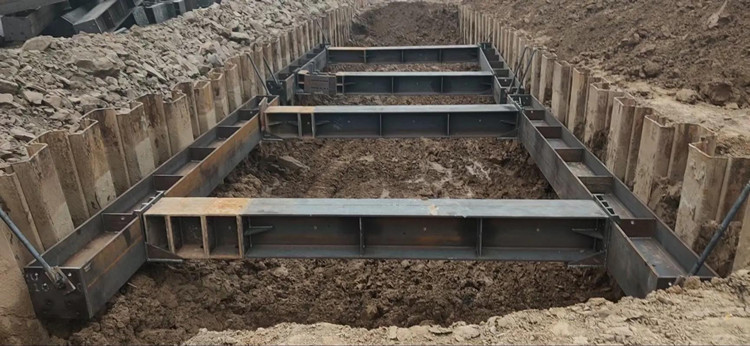
4) Permanent retaining walls: Providing soil support for highways, railways, or deep urban excavations.
5) Land reclamation: Constructing permanent perimeter walls to create new land within bodies of water.
2. How Engineers Ensure "Permanence"
To ensure a steel sheet pile wall achieves a service life of 50 to 100 years or more, engineers do more than simply drive standard piles into the ground; they implement specific strategies to guarantee permanence:
1) Corrosion allowance: For steel piles, engineers calculate the expected loss of material due to rusting over the structure's entire service life (e.g., a loss of 2–3 mm over 75 years) and specify thicker pile sections from the outset. This extra thickness acts as a "sacrificial layer" against corrosion, ensuring the structural integrity of the required effective thickness remains intact.
2) Protective coatings: Applying heavy-duty anti-corrosion coatings—such as epoxy resins, polyurethanes, or coal tar enamels—to the steel surface, particularly in the "splash zone" (the area immediately above the water line), which is highly susceptible to corrosion.
3) Cathodic protection: Sacrificial anodes (zinc or aluminum blocks) are installed on the underwater steel. These anodes corrode in place of the steel piles and can be replaced periodically, thereby extending the wall's service life indefinitely.
4) Concrete capping: A reinforced concrete "cap beam" is typically cast atop permanent sheet piles. This ties the piles together, ensures structural integrity, and protects the vulnerable pile tops from weathering and direct impact.
5) Interlock sealing: For permanent walls requiring watertightness (such as basement walls or flood walls), the interlock joints between piles can be filled with specialized sealants (e.g., bentonite or polyurethane grout) during installation to prevent water seepage.
3. Common materials for permanent sheet piles
1) Steel: The most common choice due to its high strength, ability to penetrate hard soil layers, and predictable engineering properties.
2) Vinyl/PVC/FRP (fiberglass) composites: Increasingly popular in residential and light commercial seawall projects. They do not rust or rot; provided they are shielded from direct UV exposure (usually by a concrete cap or by being buried underground), they offer a truly maintenance-free, permanent solution.
3) Concrete: Used in highly corrosive environments or where massive structural loads must be supported; however, concrete piles are heavier and more difficult to install than steel sheet piles.
4. Advantages of permanent sheet piles (compared to other methods)
Why choose sheet piles over traditional cast-in-place concrete retaining walls?
1) High space efficiency: Sheet piles are very thin and occupy minimal construction footprint or site space, making them ideal for narrow urban lots or construction right up against property boundaries.
2) Rapid installation: They are quickly driven or vibrated into the ground; compared to concrete formwork and casting, this significantly shortens construction schedules and reduces labor costs.
3) Immediate load-bearing capacity: Once driven into position, sheet pile walls can immediately resist earth and water pressures, requiring no curing time.
4) Minimal environmental impact: Compared to traditional methods, installing steel sheet piles generates less spoil and requires less concrete, thereby reducing the carbon footprint. Furthermore, the steel is 100% recyclable at the end of its (exceptionally long) service life.
5. Limitations and considerations
Despite their excellent performance, permanent steel sheet pile walls have certain drawbacks that should be considered:
1) Aesthetics: Exposed steel presents an industrial look. If high aesthetic standards are required (e.g., in waterfront residential areas), the wall often needs to be concealed using decorative finishes, concrete capping beams, or landscaping.
2) Seepage issues: Although the interlocks form tight connections, the sheet piles themselves are not completely watertight. In fine sand or silt layers, seepage can trigger "piping" (the loss of soil particles through the joints along with the water flow). Therefore, interlocks must be properly sealed, or auxiliary drainage/filtration systems installed behind the wall.
3) Construction impact: The process of driving sheet piles generates significant noise and vibration, which may be restricted in densely populated urban areas or near sensitive historic structures (although silent installation methods, such as press-in piling, are now available).
Conclusion
The application of steel sheet piles extends far beyond temporary excavation support. With the selection of appropriate materials and thicknesses, combined with suitable protective measures (such as coatings, concrete capping beams, or cathodic protection), they serve as a highly reliable, cost-effective, and widely accepted solution for permanent engineering projects.
