- tyler@shipplate.com
- +86 15603721115
In engineering, Type IIIW steel sheet piles are unique because engineers need to ensure zero settlement, even in the frequent seismic activity of the AU region. Steel is suitable only for small structures. Support columns can be driven into the appropriate space, and beams can be directly fixed to the columns. Type IIIW steel sheet piles are easily removable and reusable, making them an effective design solution.
Steel is particularly suitable for cold regions because it does not become brittle or crack due to low temperatures. However, designing a temporary sheet pile structure as a permanent project can significantly reduce costs and save programmers money. SP-IIIW sheet piles measure 600x180x13.4 and are known by various designations, such as FSP, NS-SP, SKSP, TSP, KSP, NKSP, JFE, and JFESP.
Therefore, an H-type pile wall solution was adopted because H-type piles can be driven deep into the soft lakebed mud and ultimately into the bedrock. In some cases, this meant H-piles exceeding 50 meters in length, which had to be continuously extended during driving until the required static strength was reached. Due to the high rigidity and tensile stress resistance of timber piles, anchors or cross braces were generally not required. Steel's fundamental properties, such as strength and ease of use, were fully utilized in temporary works. The wall cost just under $10 million to construct, funded by the Bay of Plenty Environment Agency and the central government.
With support from the Lakeside Sewerage Network Project, water quality improvements are expected in less than five years. The advantage of SP-3w steel sheet piles is their ease of installation, requiring virtually no excavation and no heavy equipment. For projects requiring supported excavation, hot-rolled steel sheet piles are the preferred choice.
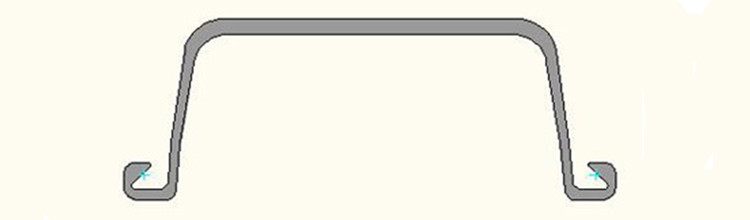
Specifications
Section | Dimensions | Sectional Area | Mass | Moment of inertia | Modulus of section | |||
Width | Height | Thickness | Pile | Wall | ||||
b | h/2 | t | ||||||
mm | Mm | mm | cm2/pile | kg/m | kg/m2 | cm4/m | cm3/m | |
ⅢW | 600 | 180 | 13.4 | 104 | 81.6 | 136 | 32400 | 1800 |
