- tyler@shipplate.com
- +86 15603721115
A sheet pile wall is a type of earth-retaining structure composed of individual profiled elements. These elements are installed into the ground—via driving, vibration, or pressing—and connected by interlocking joints to form a continuous barrier. Their primary function is to retain soil and/or water, prevent lateral displacement, and stabilize excavation faces or embankments.
1. Working Principle
Sheet pile walls function primarily as flexural members; they rely on their own bending strength to resist soil and water pressures rather than on their self-weight. Their interlocking design creates a relatively continuous and often watertight barrier, making them highly effective for groundwater control and marine engineering applications.
2. Common Materials
1) Steel: The most widely used material due to its high strength and durability, as well as its ability to withstand significant vertical loads and bending moments.
2) Vinyl and Aluminum: Lightweight and highly corrosion-resistant; frequently used in permanent marine and shoreline projects.
3) Timber: Traditionally used for temporary or light-duty retaining structures, though less common in modern heavy construction.
4) Precast Concrete: Used for heavy-duty permanent structures where significant self-weight and long-term durability are required.
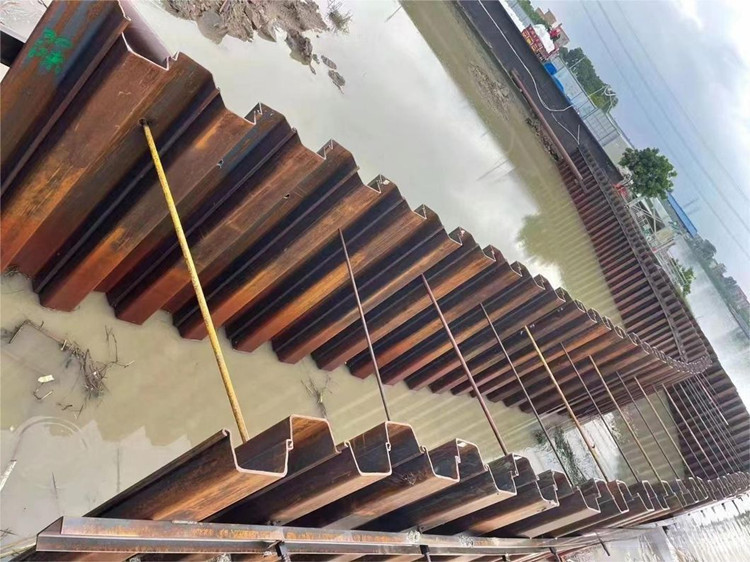
3. Types of Sheet Pile Walls
1) Cantilever Sheet Pile Wall: Stability relies entirely on the passive soil pressure (passive resistance) generated against the embedded portion of the piles. Typically used for shallower excavations or lower retaining walls.
2) Anchored Sheet Pile Wall: Features an anchoring system (such as tie-rods or anchor blocks) connected to the upper part of the wall. Anchoring reduces the required embedment depth and enables the wall to support greater heights and withstand larger lateral loads.
3) Braced Sheet Pile Wall: Reinforced by horizontal struts or bracing structures spanning the excavation; commonly used in deep basement construction or cofferdam projects.
4. Common Applications
1) Excavation Support: Used for support structures in basements, underground parking lots, pump stations, and deep foundation projects.
2) Hydraulic and Waterfront Structures: Used to construct quay walls, breakwaters/revetments, and port facilities.
3) Cofferdams: Used to create temporary watertight enclosures, allowing construction to proceed in a dry environment (e.g., for bridge pier construction or dam maintenance).
4) Flood and Erosion Control: Used as permanent flood walls or shoreline reinforcement to prevent soil erosion.
5. Advantages and Disadvantages
Advantages:
1) High space efficiency; compared to traditional gravity retaining walls, they require minimal construction site area (footprint width).
2) Suitable for a wide range of soil conditions, including soft clay layers and confined urban construction sites.
3) Steel sheet piles can typically be extracted and reused, making them an economical and sustainable choice for temporary projects.
Disadvantages:
1) The installation process (especially when using impact driving methods) can generate significant noise and ground vibration, although modern techniques (such as vibratory hammers or static press-in machines) help mitigate these effects.
2) Steel sheet piles are susceptible to corrosion in aggressive environments (such as seawater); measures such as anti-corrosion coatings, increased steel thickness (sacrificial allowance), or cathodic protection may be required over their service life.
