- tyler@shipplate.com
- +86 15603721115
Jeting (water jet-assisted piling) is an auxiliary installation technique, not a standalone piling method. It is used in conjunction with vibratory hammers, impact hammers, or pile drivers to install sheet piles.
Working Principle:
High-pressure water is pumped through a jetting pipe installed at the tip/lead edge of the sheet pile. The water jet liquefies and loosens the granular soil at the pile tip and shaft:
1. Reduces tip resistance by breaking up the soil in front of the pile tip.
2. Reduces side friction and interlocking friction: The upward-flowing water forms a lubricating layer between the pile and the soil, facilitating interlocking.
3. Loosened soil particles are transported upwards as slurry.
4. Due to reduced resistance, the sheet pile sinks under vibration, impact, or static pressure.
*Important Note: Jetting operations should stop well above the final designed pile tip height; the last 0.5–1.0 meters should be driven using a non-jetting method to restore pile-soil contact and passive earth resistance.
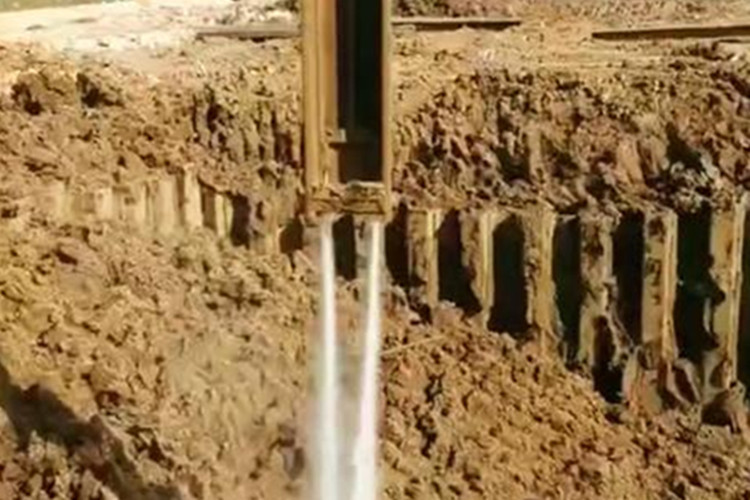
Two Jetting Methods
1. Low-Pressure Jetting
* Lower water pressure, larger water volume.
* Less soil disturbance.
* Suitable for: Medium-dense sand; requires use with a vibratory hammer.
2. High-Pressure Jetting
* Higher water pressure, smaller water volume.
* Suitable for: High-dense sand/gravel; suitable for situations with ground settlement risk (smaller total water volume).
Typical Equipment
1. High-Pressure Water Pump
2. Jetting Pipe/Nose Assembly (welded or clamped to the web or toe of the sheet pile)
3. Delivery Hose
4. Main Pile Driving Equipment: Vibratory Hammer/Pile Driver/Impact Hammer
5. Slurry Collection and Sedimentation System for Wastewater Treatment
Applicable and Inapplicable Geological Conditions
1. Most Suitable: Non-cohesive Soils—Loose to dense sand, silty sand, gravel, saturated granular soil layers (ports, cofferdam projects).
2. Not Applicable/Not Recommended:
* Hard clay: Low permeability; water cannot effectively penetrate and fluidize clay.
* Soft organic soil: Jetting can cause excessive disturbance and settlement.
* Soil containing large rocks: Jetting cannot break up large rocks.
Advantages
1. Significantly reduces pile driving resistance; 2. Can penetrate dense sand layers that pure vibration drive cannot penetrate.
2. Less hammer energy required → Reduces the risk of sheet pile damage and interlocking deformation.
3. Lower vibration output compared to heavy impact drive; advantageous for construction near existing buildings (if properly controlled).
4. Faster installation speed in difficult-to-work granular strata.
Disadvantages and Risks
1. Soil disturbance: Jetting loosens surrounding soil; may cause ground settlement of adjacent buildings or utilities. Strict monitoring is required in urban areas.
2. Generates a large amount of mud; sedimentation treatment is required before discharge (environmental requirements).
3. Uneven jetting may lead to pile misalignment/loss of verticality.
4. Over-jetting near the final depth can reduce passive soil resistance and wall bearing capacity; jetting must be stopped before the pile reaches the designed pile toe elevation.
5. Soil may be washed into the sheet pile joint; this may affect the subsequent waterproofing performance of the wall.
Construction Key Points
1. Use guide frames/formwork to control pile alignment and verticality.
2. Calibrate water pressure and flow rate through on-site test shots.
3. Stop jetting when the target pile toe elevation is reached 0.5–1 meter; final penetration should be achieved solely through vibration/compaction.
4. Continuously monitor ground settlement and nearby buildings.
5. Control and manage mud runoff to prevent water pollution.
6. Avoid over-jetting to prevent erosion of the soil behind the completed sheet pile wall.
Summary Table
Item | Jetting for sheet piles |
Nature | Auxiliary assisting method |
Primary partner plant | Vibratory hammer, press in machine |
Optimal soil | Sand, silty sand, gravel |
Main benefit | Reduce tip & skin friction |
Critical rule | Stop jetting before final penetration |
Major hazard | Ground settlement from soil disturbance |
