- tyler@shipplate.com
- +86 15603721115
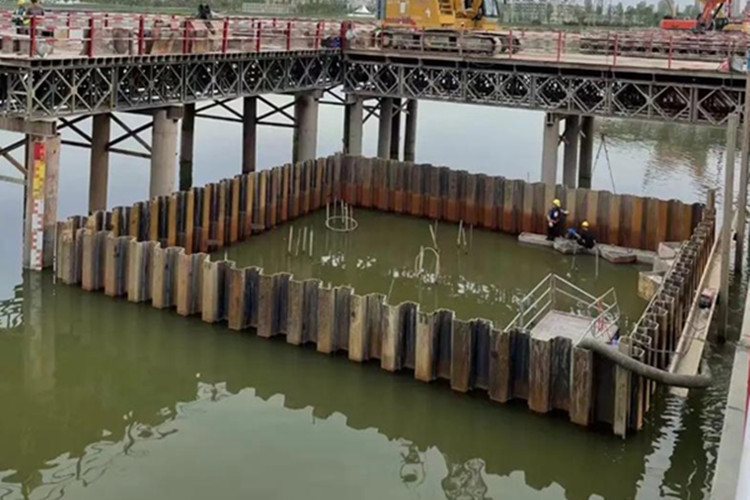
Sheet pile walls are not inherently watertight. Watertightness primarily depends on the interlocking connections between adjacent sheet piles, auxiliary sealing measures, and the quality of on-site construction.
1. Interlocking Structure (Core Structural Foundation)
Sheet piles are connected by male and female interlocking joints. The overlapping interlocking grooves create a long and winding seepage path. This extends the direction of groundwater flow and significantly reduces seepage, although some gaps still exist at the interlocking points.
1) Hot-rolled steel sheet piles: Stable interlocking geometry and large contact area, widely used in water-retaining projects.
2) Cold-formed steel sheet piles: Larger interlocking gaps, naturally poorer water-blocking performance, usually requiring additional sealants.
2. Interlocking Sealing Treatment (Key to Watertightness)
These sealants fill the gaps at the interlocking points between the piles to prevent water leakage from the joints.
1) Pre-applied sealant/grout
Before piling, asphalt, rubber, or polymer sealant is pre-applied to the interlocking grooves. After piling and locking, the sealant is compressed and fills the gaps. Suitable for temporary and permanent cofferdams.
2) Grouting
After piling, a cement-bentonite mixture or chemical grout is injected into the interlocking cavities through pre-drilled holes. The grout cures within the joints, thus blocking leakage paths. Used for permanent cutoff walls requiring low permeability.
3) Rubber gaskets
Elastic rubber strips are installed within the interlocking structure. They are compressed during piling to form a physical waterproof seal. More common in composite or concrete sheet pile systems.
3. Construction Process
1) Pile verticality: Inclined installation will increase the interlocking gaps, causing serious leakage. Strict control of verticality during piling is crucial.
2) Full interlocking: Each sheet pile must be fully inserted into the interlocking joints of adjacent sheet piles; partial interlocking will create leakage channels.
3) Avoid Interlock Damage: Driving vibrations and impacts can cause interlocking profiles to deform or tear. Damaged interlocks cannot seal properly and require repair.
4. Secondary Water Interception Measures (For Strict Low Leakage Requirements)
When extremely low leakage is required, sheet pile joints alone are insufficient. Additional barrier systems are needed:
1) Bentonite Cement Backfill/Interception Trench: Low-permeability trenches are installed along the wall to intercept leakage bypassing the sheet pile toes.
2) Pile Toe Jetting/Soil Mixing: Sealing the gaps below the bottom of the sheet piles to prevent bottom leakage.
Important Note
Zero leakage is rarely achievable with sheet pile walls. Good design and sealing aim to limit leakage to acceptablely low levels, not absolute watertightness. For permanent structures where minimal water seepage is required, composite material systems are used.
