- tyler@shipplate.com
- +86 15603721115
All lightweight sheet piles are coated with 375 microns of Jotamastic 87 black paint at the top 3.35 meters of the front and the top 4.0 meters of the back. Box piles, consisting of four AZ sections, a pair of AZ sections and a plate, or a pair of U sections, can be easily introduced into the sheet pile line at any point where a heavy load needs to be applied. Sheet pile walls can be inserted into pre-cut grooves or pressed, impact-driven, or vibrated into place. EU8 sheet piles are coated with 375 microns of Jotamastic 87 black paint at the top 3.35 meters of the front and the top 3.35 meters of the back. All coating work is performed at the ESC factory in China. KLS2 can also be used as independent load-bearing piles in foundations or in open pier and wharf construction. The driving force is transmitted concentrically to the pile, but the reaction force is not evenly distributed across the sheet pile.
Its large turning radius makes it particularly suitable for construction involving long piles with little or no lateral support. To prevent sheet piles from tilting, they should be secured to guide frames or brackets. All sheet piles for this project were delivered in March 2009. KLS3A may occur in compacted soil if the soil has been loosened by previous sheet piles.
Lightweight steel sheet piles KLS2, KLS3A, and KLS3 are typically driven with an open end. Because the soil enters the open end of the pile during initial drive and forms an effective plug as the pile toe depth increases, soil displacement and ground heave are generally avoided. Pile driving and compression require no hammering or impact, unlike percussive and vibratory piling methods. In complex soils, piling operations can be simplified by pre-drilling, water injection, pre-blasting, or even soil replacement. An additional clutch is included to ensure that the KLS3 can be fabricated on-site without project delays if turns or obstacles necessitate changes to the piling route.
Forward tilt is caused by friction in the interlocking mechanism and soil compaction during the driving of the previous sheet pile. Sheet piles can be driven into all common soils, very compacted ground, and soft rock formations. Obstructions in the soil or angles of hard ground can interfere with vertical alignment during driving. Sheet piles can resist both vertical and horizontal forces and can generally be placed within the wall without affecting its appearance. When driven into a sheet pile wall, the pile may tilt forward or backward relative to the driving direction.
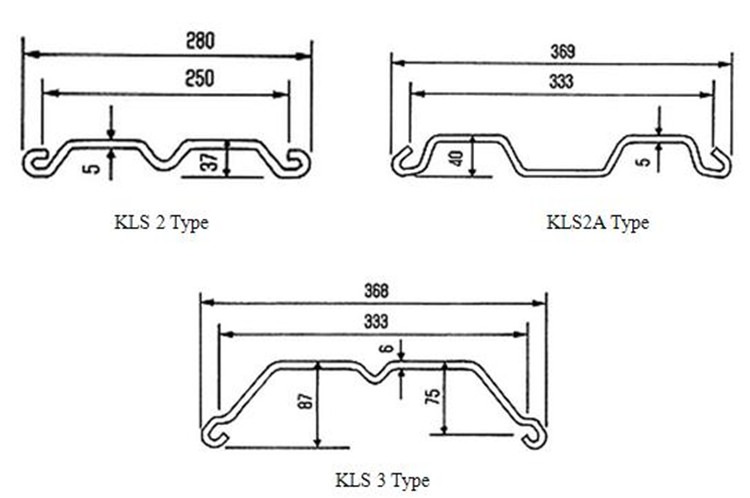
Specifications
Dimensions | Weight | Per meter of wall | |||||
Types | Thickness | Width | Height | Per pile | Per wall | Modulus of Section | Moment of Inertia |
mm | mm | mm | Kg/m | Kg/m2 | Cm3/m | Cm4/m | |
KLS2 | 5 | 250 | 37 | 14.8 | 59.2 | 59.7 | 107 |
KLS2A | 5 | 333 | 40 | 19.5 | 58.5 | 76.8 | 154 |
KLS3 | 6 | 333 | 87 | 23.3 | 69.9 | 330 | 2480 |
