- tyler@shipplate.com
- +86 15603721115
The distinguishing feature of this wall type is that it allows for a variety of scenarios by combining different beams, sheet piles, and connectors. When a lightweight sheet pile no longer connects properly to adjacent sheet piles, this condition is known as decoupling. Their perimeter must be able to withstand the possibility of a large-scale failure of the tank and the release of all liquids into the surrounding area. Visual inspection is possible for sections of the sheet pile wall that remain visible after being driven, but signal transmitters are required for sections of the wall buried using ASP-2 and ASP-II.
Furthermore, this liquid has a high potential for ignition, so this potential issue must also be considered around the perimeter. Various combinations of steel sheet pile walls are available, consisting of single or double layers of PSp pile segments and intermediate sheets. Grand Piling works closely with ArcelorMittal through its European agents. The table below lists the ASP-2 that can be produced for specific component combinations.
Lightweight steel sheet piles, with their wide profile, are an ideal choice because the number of piles per meter of wall is very limited. The pile foundation is at least half as leak-proof as other sheet piles, which also means a lower risk of leakage for contractors. In this type of structure, the sheet pile wall transfers earth and water pressure loads to the piles, and the ASP-II can construct heavy-duty retaining walls, such as quay walls. Arcelor performed calculations to ensure that the strict requirements of the client and contractor were met while staying within budget constraints.
Even with careful driving, the possibility of interlocking failure cannot be completely ruled out. Checking for decoupling is recommended to improve the reliability of the sheet pile wall. Hanzi won the project with our sheet pile solution.
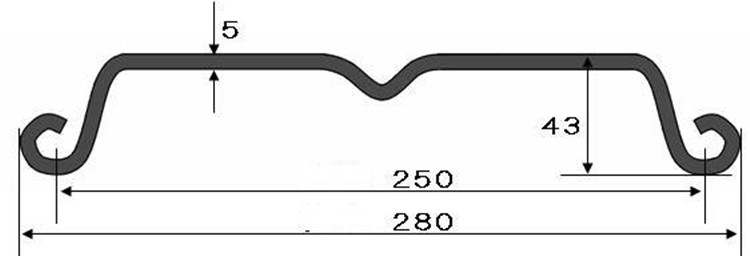
Specifications
Dimensions | Weight | Per meter of wall | |||||
Types | Thickness | Width | Height | Per pile | Per wall | Modulus of Section | Moment of Inertia |
mm | mm | mm | Kg/m | Kg/m2 | Cm3/m | Cm4/m | |
ASP-2 | 4 | 250 | 42 | 11.8 | 47.2 | 48.6 | 85.1 |
ASP-II | 5 | 250 | 43 | 14.8 | 59.2 | 59.7 | 107 |
