- tyler@shipplate.com
- +86 15603721115
Hoesch sheet piles have been updated with new profiles (Europile/STS, Profextru). The cold-formed sheet pile profile library now offers three sizes: H1105, H1205, and H1205K. The maximum bending moments for the composite profiles in the library are now characteristic values (without safety factors). Concrete sheet piles are often prestressed to facilitate handling and driving. Due to the limited quantities required, H2555 and H2605 profiles are typically made from reinforced concrete. Australian roll-formed manufacturers produce a wide range of standard and custom sheet pile products to meet the needs of various applications and conditions.
During the import process, two factors (the correction factor kmod and the partial material factor) are applied to obtain the design values used in the calculations (see Figure 4.9). H1255, H1705, and H1705K are suitable for marine environments, highly abrasive riverbeds, and where the sheet piles must withstand significant axial loads. Experience has shown that these piles can cause settlement in soft foundation materials due to their deadweight. Site guidance is essential for conveying design intent to field personnel. Designers should prepare a report that includes at least the following information. Steel sheets are cold-formed to ensure accurate profile and straightness. Rigorous quality control ensures performance and scour resistance standards. H2505, H2555K Version 15.1. This version includes numerous minor improvements and bug fixes; please visit our website for a complete list:
Sheet piles are interlocking corrugated sheets with depths from 20 to 4 inches and thicknesses from 0.10 to 0.188 inches, made from 5052 or 6061 aluminum alloy. H1755 and H1805 sheet piles are designed to provide maximum strength while ensuring accurate and easy driving, extraction, and handling. The main improvement is the new Plastic Wall module, which allows for plastic analysis of walls (Section 1.3.4) by entering a moment-curvature (MN-Kappa) diagram for the cross-section (Figure 4.27). A tutorial has been added to this manual (Chapter 26) on how to perform plastic analysis on piles. It is lightweight and easy to handle—approximately 15 kg per meter. LP 042/61 requires only a lightweight pile hammer, a simple drill, and tools. However, in this case, the wall's watertightness may be lost.
Figure 2-6 shows typical concrete sections H1755, H1805, and H2505. Such pile foundations are not readily available in all regions. Common applications for the H1705 and H1705K include trenching; a warning message displays upon program startup, reminding the user to correctly estimate relative density for vibratory settlement calculations; hydraulic engineering projects, such as dams, core walls, and cofferdams; waterway engineering projects, such as canal walls, quay walls, and retaining walls; erosion control projects, such as weirs, beach groynes, and cliff protection; and structural engineering projects, such as excavation and retaining walls, foundation underpinning, formwork, bridge decks and piers, breakwaters, piers, and causeways. Lightweight aluminum. These sections have relatively low section moduli and moments of inertia, necessitating the use of tie rods in most cases. Z-section H1205K and H1255 sections are also available in 6-inch depths and up to 0.25-inch thicknesses. Aluminum sections should be considered for shoreline erosion projects and for low-profile diaphragm walls exposed to salt or brackish water when embedded in well-drained granular material.
LP042/61 steel sheets are durable, whether used for permanent installation or reused for various temporary needs. D-SHEET PILING can only be used to analyze diaphragm walls, sheet pile walls, and single piles. For pile group analysis, use the D-PILE GROUP program from Deltares Systems. 1.6 Minimum System Requirements: The steel sheets are cold-formed to ensure accurate profile straightness. Strict quality control ensures standard performance and scour resistance.
We also offer piles made from specialized materials such as vinyl, polyvinyl chloride, and fiberglass. These piles have lower structural bearing capacity and are typically used for tiebacks. When using H2555K, H2555, and H2605, the following limitations apply: Vertical pile driving.
Horizontal soil layers. Design assumptions regarding subsurface and site investigation interpretation. EC7-General verification calculations have been improved (name and selection of Method A or B in the report overview table). 1.5 Limitations: The usable length of piles is shorter than with other materials. H1105 and H1205 must be obtained from the manufacturer and carefully evaluated by the designer for each application.
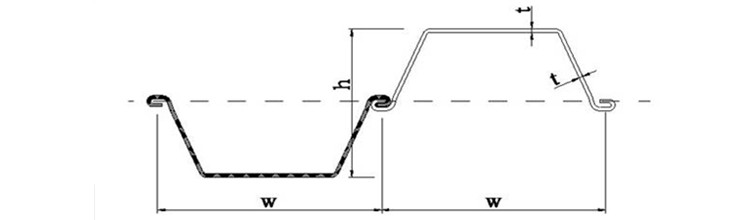
Specifications
Section Name | Section modulus | Weight | Second moment of inertia | Back thickness | Web thickness | Wall height | Section width | ||
Wy cm3/m | cm3 | kg/m2 | kg/m | Iy cm4/m | t | s | h | b | |
Wall | Single pile | Wall | Single pile | Wall | mm | mm | mm | mm | |
Finger Socket interlocks | |||||||||
H1105 | 1100 | 633 | 101.0 | 58.1 | 14300 | 8.8 | 8.8 | 260 | 575 |
H1205 | 1140 | 655 | 107.0 | 61.5 | 14820 | 9.5 | 9.5 | 260 | 575 |
H1205K | 1200 | 690 | 112.5 | 64.7 | 15600 | 10.2 | 10.2 | 260 | 575 |
H1255 | 1250 | 719 | 118.0 | 67.9 | 16250 | 10.8 | 10.8 | 260 | 575 |
H1705 | 1720 | 989 | 116.0 | 66.7 | 30100 | 10.0 | 9.0 | 350 | 575 |
H1705K | 1700 | 978 | 117.0 | 67.3 | 29750 | 9.5 | 9.5 | 350 | 575 |
H1755 | 1750 | 1006 | 120.8 | 69.5 | 30625 | 10.4 | 9.5 | 350 | 575 |
H1805 | 1800 | 1035 | 125.0 | 71.9 | 31500 | 10.8 | 9.9 | 350 | 575 |
H2505 | 2480 | 1426 | 152.0 | 87.4 | 43400 | 12.5 | 9.5 | 350 | 575 |
H2555K | 2540 | 1460 | 155.0 | 89.1 | 44450 | 12.8 | 10.0 | 350 | 575 |
H2555 | 2550 | 1466 | 158.1 | 90.9 | 44625 | 13.0 | 10.0 | 350 | 575 |
H2605 | 2600 | 1495 | 162.3 | 93.3 | 45500 | 13.3 | 10.3 | 350 | 575 |
