- tyler@shipplate.com
- +86 15603721115
The coordination required for AZ sheet piles depends on the project type and location. The figure shows a free soil support scenario. The Feasibility module allows users to compare their AZ18-800 and AZ20-800 sheet pile wall designs with relevant construction experience data and Dutch NVAF lines. The deflection of a diaphragm wall is somewhat similar to that of a vertical elastic beam with its lower end simply supported (B) and the other end fixed, as shown in AZ32-750. The Vibration Settlement module allows users to determine the settlement caused by vibratory installation and removal of sheet piles. Settlement is primarily caused by soil compaction and the installation or removal of sheet piles.
Coordination and cooperation between sheet piles must be continuous from the project's inception to final commissioning. The Plasticity module, AZ30-750, performs plastic analysis of diaphragm walls, sheet pile walls, or monopiles, taking into account the flexural behavior of the cross section. Initially, these engineering disciplines must consider alternative wall types and arrangements to determine real estate requirements. The forces acting on the sheet piles include: active pressure generated by the AZ28-750 pile, which helps reduce failure costs during driving/vibration. Without a license, this module operates in demonstration mode; passive pressure generated by the soil in front of the pile; and tension in the anchor bolt. This model, implemented in AZ22-800 and AZ23-800, is based on a model developed by Meijers (Meijers and Tol, July 2010) (Meijers, December 2007).
The moment-curvature relationship for this cross-section is used to predict its stiffness. This moment-curvature relationship has several ramifications. Throughout the design and construction process, close coordination and consultation between AZ20-800 and local stakeholders was essential, as they share the project costs and are responsible for acquiring the right-of-way, completing the relocation, and operating and maintaining the project after completion. Currently, experience with AZ27-800 primarily comes from the Netherlands; for example, in port construction where the route is determined by the water source, or where the wall serves as a connection to a major structure such as a lock or dam. The distance of the inflection point below the dredging water level (i) can be correlated with the internal friction angle AZ18-800, as shown in the table below.
In urban or industrial areas, AZ25-800 requires consideration of multiple alternatives, which must be closely coordinated with local interests. Therefore, its relevance to other regions of the world may be limited. In other cases, the options may depend on the system configuration, such as the space requirements for anchor walls or the required right-of-way for floodwall/dike systems. AZ25-800 and AZ27-800 can calculate compaction and pore pressure during sheet pile installation and removal.
Other disciplines must review proposed projects to determine their impact on existing facilities and the environment. Throughout the project implementation process, from design to construction and commissioning, all relevant personnel should conduct visual inspections of AZ28-750, AZ30-750, and AZ32-750. Figure AZ23-800 shows the deflected shape of an anchored sheet pile with fixed soil support. The final calibration must meet the general requirement of achieving the best possible compromise between economy and minimal environmental impact. AZ22-800 changes its curvature at inflection point I. The soil into which the pile is driven exerts significant constraints on the lower portion of the pile, resulting in changes in curvature. The calibration of a sheet pile wall may depend on its function.
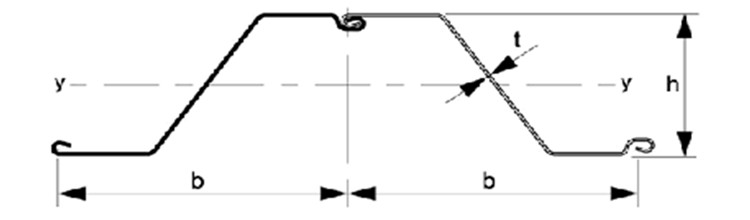
Specifications
Section | Dimensions | Weight | Moment Of interia | Modulus of section | ||||
b | h | t | s | |||||
mm | mm | mm | mm | kg/m | kg/m2 | cm4/m | cm3/m | |
AZ 18-800 | 800 | 449 | 8,5 | 8,5 | 80,7 | 100,9 | 41 320 | 1 840 |
AZ 20-800 | 800 | 450 | 9,5 | 9,5 | 88,6 | 110,7 | 45 050 | 2 000 |
AZ 22-800 | 800 | 451 | 10,5 | 10,5 | 96,4 | 120,5 | 48 790 | 2 165 |
AZ 23-800 | 800 | 474 | 11,5 | 9,0 | 94,6 | 118,2 | 55 260 | 2 330 |
AZ 25-800 | 800 | 475 | 12,5 | 10,0 | 102,6 | 128,2 | 59 410 | 2 500 |
AZ 27-800 | 800 | 476 | 13,5 | 11,0 | 110,5 | 138,1 | 63 570 | 2 670 |
AZ 28-750 | 750 | 509 | 12,0 | 10,0 | 100,8 | 134,4 | 71 540 | 2 810 |
AZ 30-750 | 750 | 510 | 13,0 | 11,0 | 108,8 | 145,0 | 76 670 | 3 005 |
AZ 32-750 | 750 | 511 | 14,0 | 12,0 | 116,7 | 155,6 | 81 800 | 3 200 |
