- tyler@shipplate.com
- +86 15603721115
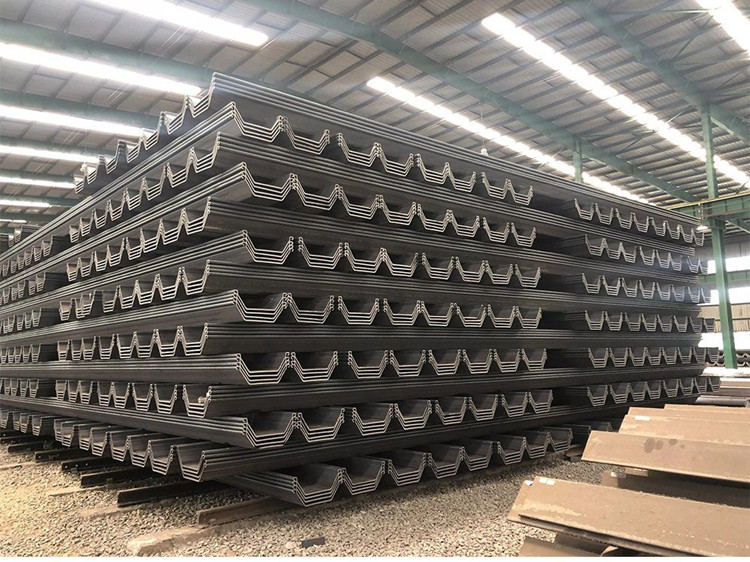
Checking the quality of steel sheet piles is a key link to ensure the stability and safety of the foundation pit supporting structure. Quality inspection usually runs through the entire cycle of material arrival, construction process and final acceptance, mainly covering the following core dimensions:
1. Inspection of incoming materials
After the steel sheet piles arrive at the construction site, they must be strictly verified from the following six aspects:
1) Material certification: Check whether the material meets the design requirements (such as Q235 or Q355), check the factory certificate, material certification documents and third-party retest reports (including chemical composition analysis, tensile and bending tests, etc.).
2) Specifications and models: Verify whether the thickness, width, length and other dimensions are consistent with the design drawings. For example, the dimensions and unit weight of Larson type III or IV steel sheet piles must comply with standards.
3) Appearance defects: Check whether there are cracks, folds, scars, slag inclusions and other defects on the surface of steel sheet piles; for severely corroded piles, the actual section thickness needs to be measured and reduced for evaluation.
4) Flatness and deflection: Use a 1-meter ruler to check the corrugation or bending of the steel sheet pile surface. The gap should generally be no more than 5mm; at the same time, check the overall deflection of the pile body (the allowable deviation is usually less than 2%L, L is the length of the pile).
5) Coating integrity: If the design requires an anti-corrosion coating, it is necessary to check whether the steel sheet pile coating is complete and whether there is peeling or peeling, and the number and thickness of the layers must meet the design standards.
5) Lock status: Focus on checking whether the shape of the lock is intact, smooth, without burrs, and without deformation. Standard pile sections can be used for passing tests to ensure tight splicing and meet water-stop requirements.
2. Construction process quality control
During the construction process, process parameters need to be monitored in real time to ensure construction quality:
1) Verticality monitoring: The verticality of each pile must be measured and monitored at any time during driving. It is generally required that the verticality deviation does not exceed 0.5% to 1%. When the deviation is too large, the steel sheet pile must be pulled out and driven again.
2) Axis and elevation control: Use a total station or theodolite for positioning to ensure that the pile axis displacement is controlled within 50mm and the pile top elevation deviation is controlled within ±50mm.
3) Piling quality: If welding is required, the weld should be full, free of slag inclusions, and pores. After completion, visual inspection and non-destructive testing are required; mechanical piling needs to ensure the tightness of the joint and reliable connection strength.
4) Installation of the support system: Check whether the internal supports, purlins, etc. are set according to the plan, are accurately positioned, firmly installed, and can fit closely with the steel sheet piles to effectively control deformation during the excavation process.
3. Completion acceptance and monitoring
After the construction is completed, the overall support system of steel sheet piles needs to be comprehensively verified:
1) Deformation and settlement monitoring: During the excavation stage of the foundation pit, the horizontal displacement of the pile top and the surrounding surface settlement are monitored daily. The warning value is usually 0.3% of the depth of the foundation pit, and the early warning value for deep soil displacement is generally 20-30mm/24h.
2) Verification of water-stopping effect: Through pumping test or direct observation of water level changes in the foundation pit, determine whether there is continuous leakage at the lock. If water leakage is found, measures such as high-pressure grouting or external water-stop piles must be taken promptly.
3) Pile body integrity inspection: If necessary, ultrasonic testing and other means can be used to randomly inspect the integrity of the steel sheet piles, and visually confirm that there is no continuous leakage at the lock.
