- tyler@shipplate.com
- +86 15603721115
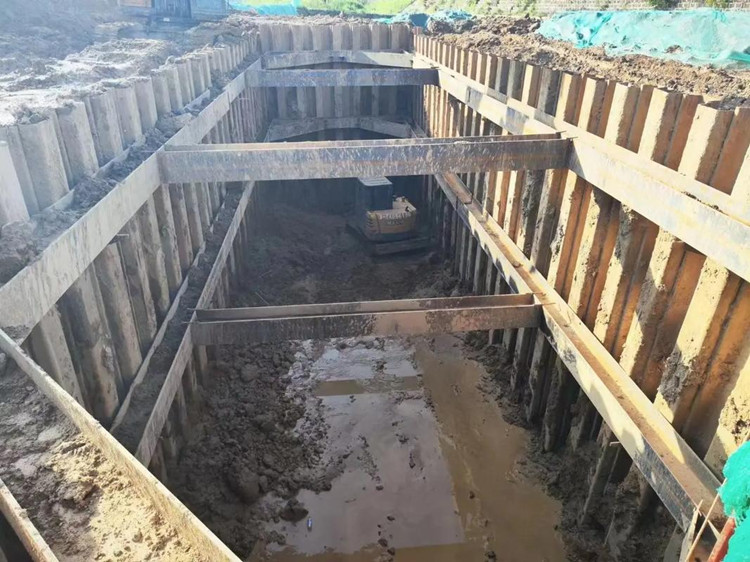
Steel sheet pile installation is a complex operation involving deep excavation support, earth retention, and waterproofing. To ensure structural safety and construction quality, it is recommended to follow this standardized, end-to-end installation guide:
1. Preliminary Preparation and Site Investigation
1) Site and Environmental Assessment: Thoroughly understand the geological conditions (e.g., soil stratification, bearing capacity), groundwater levels, and surrounding environment (adjacent buildings, underground utility locations) of the installation site; identify potential risks and formulate emergency response plans.
2) Precise Surveying and Layout: Use instruments such as total stations to accurately locate the position and elevation of the steel sheet piles; pre-construct drainage ditches around the excavation perimeter to prevent surface water inflow.
3) Equipment Selection and Configuration: Select appropriate pile-driving equipment based on geological conditions and environmental requirements. Hydraulic vibratory hammers or static pressing methods (low noise) are suitable for soft soil layers, while diesel impact hammers are appropriate for hard soil or rock strata.
2. Material Inspection and Pre-treatment
1) Visual and Material Inspection: Inspect each steel sheet pile for length, width, thickness, interlock profile, and surface corrosion. Reject piles that are severely deformed or defective; conduct chemical composition and mechanical property tests if necessary.
2) Deformation Correction: Repair piles exhibiting longitudinal or lateral bending, localized deformation, or interlock distortion using methods such as cold-bending correction with jacks, sledgehammering, or oxy-acetylene heating to ensure flatness meets standards.
3) Handling and Stacking Protocols: Use a two-point lifting method when loading or unloading piles, taking care to protect the interlocks from damage. The stacking area should be level and solid; stack piles in layers separated by dunnage, categorized by specification, with a total stack height not exceeding 2 meters.
3. Guide Frame Installation and Pile Driving
1) Guide Frame Installation: To ensure the correct pile-driving axis and verticality, install a sturdy, single-layer, double-sided guide frame (construction waler). Adjust the position of the guide beams using a transit and level, ensuring they do not sink or deform as the pile is driven deeper. 2) Precise positioning of initial piles: The first two steel sheet piles driven serve as a guide template; their position and orientation must be strictly controlled. Measurements must be taken after every meter of penetration to ensure deviations remain within permissible limits.
3) Driving process control:
* Interlocks may be lubricated with grease to facilitate driving; insertion must be performed slowly to avoid damaging the interlocks.
* Continuously monitor pile verticality (deviation generally should not exceed 1%); if excessive tilting occurs that cannot be corrected, the pile must be extracted and re-driven.
* When the pile reaches a depth 20–40 cm above the design elevation during vibratory driving, proceed with caution to prevent over-driving.
4. Bracing reinforcement and groundwater control
1) Timely installation of bracing: As the excavation proceeds in stages, steel or concrete capping beams (waling), corner braces, or tie rods must be installed concurrently to form a stable, integrated support system.
2) Groundwater management: Strictly control the groundwater level using methods such as well-point dewatering or sump pumping to prevent ground collapse caused by water leakage carrying away soil particles. If stringent waterproofing is required, rubber strips may be inserted into the interlocks or waterproof coatings applied.
5. Comprehensive monitoring and safety maintenance
1) Dynamic monitoring and early warning: Continuously monitor surrounding ground settlement, pile displacement, and groundwater level changes during construction. If significant tilting or heaving is detected, additional symmetrical bracing must be installed immediately.
2) Quality acceptance upon completion: After the steel sheet piles are installed, conduct a comprehensive inspection of verticality, pile top elevation, and interlock sealing to ensure all parameters meet design and specification requirements.
6. Pile extraction and subsequent treatment
1) Safe extraction operations: Piles may only be extracted after the excavation has been backfilled to the specified elevation. Vibratory hammers are the preferred method for extraction; for piles that are difficult to remove, a crane may be used to provide upward pulling force while simultaneously vibrating to reduce soil adhesion.
2) Grouting and backfilling of voids: The vibration generated during pile extraction may cause soil displacement; the resulting pile voids must be promptly backfilled via grouting to prevent ground settlement and ensure the safety of surrounding roads and underground utilities.
