- tyler@shipplate.com
- +86 15603721115
The rectification of steel sheet piles generally involves two stages: "pre-installation material preparation" and "dynamic alignment correction during installation." Specific correction methods for various types of deformation are as follows:
1. Correction of Materials and Components Prior to Installation
Before driving the steel sheet piles into the ground, their appearance and geometric dimensions must be inspected, and any defective or deformed piles must undergo targeted repairs:
1) Correction of surface defects: First, clean rust and oil stains from the surface area surrounding the defect; then, fill the area via welding and smooth it down using a grinding wheel.
2) Correction of end-face perpendicularity: Typically, the pile end is cut using oxy-acetylene equipment to ensure it is perpendicular to the longitudinal axis, followed by grinding the cut surface smooth; if the amount of material to be removed is minimal, grinding alone may suffice.
3) Correction of pile body deflection:
* Web-direction bending: Secure both ends of the bent section to supports, then use a jack mounted on a gantry-style frame to perform cold-bending correction at the points of concavity or convexity.
* Lateral bending: Secure both ends of the bent section on a dedicated correction platform, then use jacks positioned at intervals to press against the convex areas for cold-bending correction.
4) Correction of pile body twisting: Depending on the specific nature of the twist, the deflection correction methods described above may be employed.
5) Correction of localized cross-sectional deformation: For localized deformations, a combination of methods is used, including jacking pressure, sledgehammer impacts, and heating with an oxy-acetylene flame.
6) Correction of interlock deformation: Use a standard steel sheet pile as a shaping jig for the interlock and adjust it by pulling with a slow-speed winch, or straighten it by heating with an oxy-acetylene flame while driving the jig forward using sledgehammer blows.
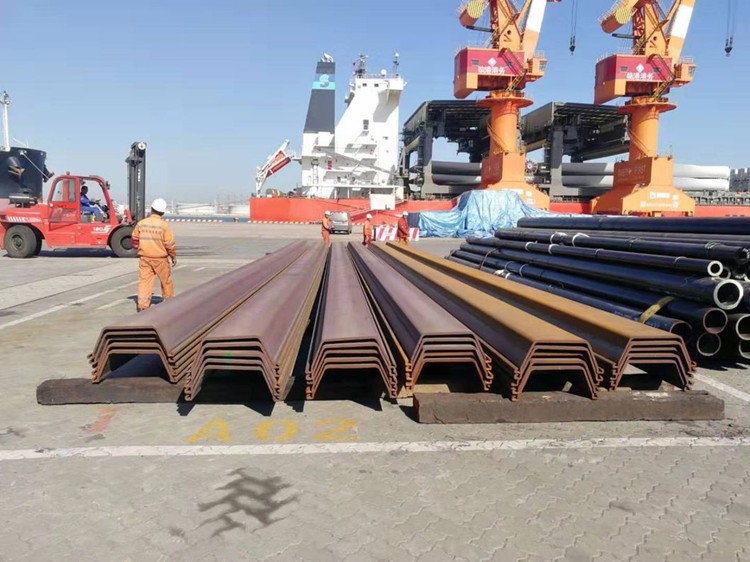
2. Dynamic Correction and Control During Driving
During the actual driving process, issues such as tilting may arise due to complex geological conditions or operational factors; therefore, the following control measures should be implemented:
1) Precise positioning of initial piles: The location and orientation of the first one or two steel sheet piles (reference piles) must be highly accurate (positional deviation ≤ 5 mm; verticality deviation ≤ 0.5%) to serve as a guiding template. Measurements should be taken after every meter of penetration to prevent the accumulation of errors.
2) Real-time instrument monitoring: To ensure verticality during driving, two theodolites should be used to monitor the pile from two directions. If excessive deviation is detected, the pile hammer angle must be adjusted immediately, or a wedge-shaped pile used for correction.
3) Correction via external traction: If a steel sheet pile begins to tilt, a steel cable can be used to pull the top of the driven pile in the direction opposite to the tilt; driving and pulling should be performed simultaneously to gradually correct the alignment.
4) Adjustment using wedge-shaped piles: When the tilt is excessive, wedge-shaped steel sheet piles can be inserted to adjust the alignment and restore the leading pile to the correct vertical position for construction.
5) Auxiliary anti-tilt measures: To prevent rotation or tilting during sinking, a locking clamp can be used to secure the leading interlock in the direction of driving; simultaneously, fixed pulley brackets should be installed in the gaps between the steel sheet pile and the waler on both sides to restrain rotation.
