- tyler@shipplate.com
- +86 15603721115
There's a common misconception that steel sheet pile driving involves hammering steel into the ground with a large hammer, creating significant noise. While impact pile driving is still in use, much work has been done to reduce its environmental impact. Other installation methods have been developed to eliminate impact noise and increase driving speed. In short, there are three main pile driving systems suitable for retaining and load-bearing piles: impact-driven, vibration-driven, and clamp-driven.
1. Impact-Driven
The most common type of impact pile driving is drop hammer driving, which uses a falling hammer to generate impact force, which is then transferred to the top of the pile through a pile cap. Currently, the most commonly used drop hammer is the hydraulic hammer. Historically, pneumatic hammers and diesel hammers have also been used, utilizing explosive force to drive the hammerhead. However, due to the higher efficiency and significantly lower noise levels of newer hydraulic hammers compared to older diesel hammers, the use of diesel hammers has greatly decreased.
2. Vibration Drive
An vibration actuator is clamped onto the top of the pile, causing it to vibrate. This reduces friction on the pile's sides, allowing the pile to be driven into the ground with less additional force.
3. Pressing (Prying)
Push-in piling utilizes the reaction force of adjacent piles, driving the pile into the ground through a jacking action. This method produces less noise and vibration, making it suitable for sensitive sites. There are two main types of push-in piling machines: "Japanese-style" piling machines, such as those from Giken and Tosa; and panel-mounted piling machines. Additionally, specialized devices can convert guide rod piling machines into push-in piling machines.
Japanese piling methods use a drilling rig that can move along the pile line, eliminating the need for cranes to lift each pile individually, as in traditional methods, thus reducing site requirements. These drilling rigs are typically designed for specific pile cross-sectional dimensions, making the matching of pile cross-section dimensions to the piling method crucial.
Sheet pile drive/pressing equipment is primarily suitable for construction in heavy clay soils, requiring a crane to move the press rods from one pile to another. Early multi-press presses also required bolting the sheet piles to each pile, but recent technological advancements have eliminated this requirement.
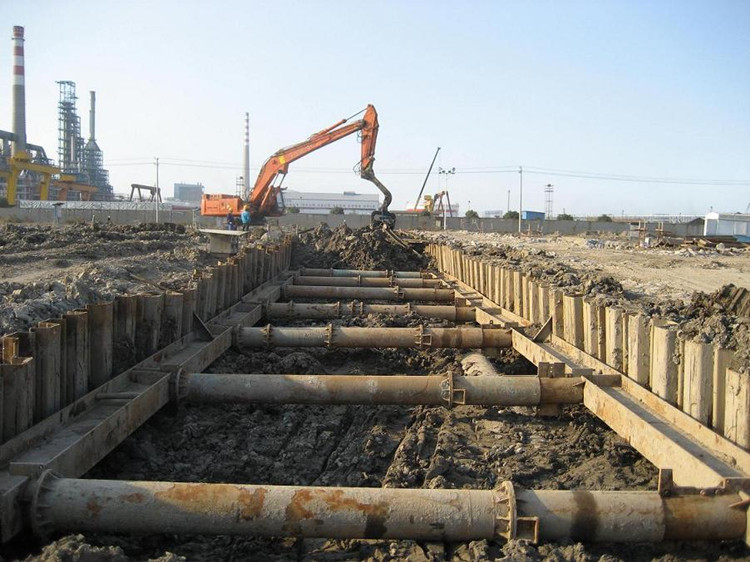
4. Drive-Assisted Methods
Drive-assisted methods can significantly improve the construction efficiency of sheet pile walls. Jetting and pre-drilling are the main methods.
1) Jetting involves delivering water to the soil at the foot of the steel sheet pile to reduce friction.
2) Pre-drilling refers to drilling into the soil along the pile line using a continuous auger before installing the sheet piles. With this technique, only the soil around the pile line needs to be loosened; soil removal is not required.
Both methods alter the in-situ soil properties around the steel sheet piles, and their effects must be considered during the design process. In particular, the definition of unfavorable foundations takes into account different drive-assisted methods when determining βD and βB, as they affect the side friction and interlocking friction of the installed sheet piles. Furthermore, the applicability of these methods in other aspects, such as foundation movement and the formation of contaminant diffusion paths, needs to be considered.
5. Method Selection
For certain geological conditions, especially layered geology (granular sediments overlying clay sediments, or vice versa), it is best to use a combination of methods. Some specialized equipment can implement multiple construction methods, but different drilling rigs are usually required.
6. Sheet Pile Installation Methods
There are two basic methods for installing steel sheet piles: "inclined driving" and "segmented driving."
1) Throwing and Driving
This method involves driving piles one by one. Unless verticality is strictly controlled, this method is prone to causing the pile to tilt forward and exceed tolerances. Using more modern equipment allows for better control of verticality. Furthermore, since the pile is supported by only one locking clip during driving, rotation of the pile around its vertical axis is also a risk.
Inclined driving is best suited for short piles and is the only method that can be used in conjunction with the "Japanese" silent press-in method. For piles partially completed using the inclined pile driving method (rather than the "Japanese" silent press-driven pile driving method), the remaining portion can usually be completed using the segmented pile driving method if necessary.
2) Panel Drive
Using the segmented pile driving method, because multiple piles are pre-connected before driving, it is easier to control verticality. The pile group is supported by a guide frame and then driven in stages sequentially. Compared to the segmented pile driving method, this method can install longer piles in more complex geological conditions. Recent developments in multi-cylinder presses have improved the application prospects of the segmented pile driving method.
7. Load-Bearing Pile Installation Methods
Installing load-bearing piles is a highly specialized task, requiring extensive knowledge and experience in pile handling, as well as hammer operation skills, to achieve an acceptable installation position within the specified position and level tolerances.
Regarding the practical limits achievable in terms of position and level for steel piles, relevant guidance is provided in the book "Steel Sheet Pile Installation" published by FPS (Federation of Pile Experts) and TESPA (European Association of Steel Sheet Pile Techniques). Furthermore, relevant guidance is also included on the back of the ICE (Institution of Civil Engineers) Code for Pile Foundations and Embedded Retaining Walls.
Designers should consult these documents before designing, as the recommendations provided often influence the details of pile cap connections in the structure.
Many benefits can be gained by matching the pile stiffness to the hammer and the expected soil resistance of the site, thus achieving satisfactory piling performance and ensuring the required design penetration depth is reached.
Load-bearing piles can be installed using the same methods as the steel sheet piles described above.
