- tyler@shipplate.com
- +86 15603721115
Driving tolerances for sheet piles refer to the permissible deviations in position, verticality, and horizontality during installation. While specific tolerances depend on the project and applicable standards, achieving perfect theoretical precision in sheet pile wall construction is impossible.
Typical construction tolerances cover limits on lateral position, vertical deviation, and the elevations of the pile top and toe. In reality, some deviation is to be expected, as the piles interact with actual soil conditions, equipment, and potential obstructions. The goal is not zero deviation, but rather keeping deviations within a range that ensures wall performance, interlock continuity, and the integrity of connection details.
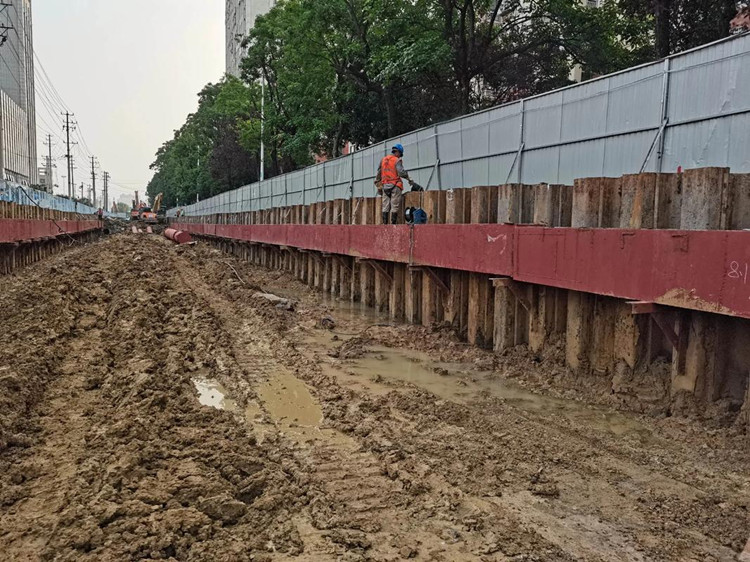
1. I believe tolerances are among the most misunderstood aspects of sheet piling projects.
Many non-specialists assume that if the design drawings show a perfectly straight wall line, the installed wall should match it almost perfectly. That is not the case. Sheet piles are long steel elements driven into natural ground—and the ground is never perfectly uniform. The installation equipment itself moves, interlocks allow for slight rotation, and obstructions can appear unexpectedly. Consequently, there will always be a margin of error in the wall's alignment.
2. The critical question isn't "Will the wall be perfect?" but rather "How much deviation can the wall and structure tolerate without compromising performance?"
Guidelines for steel pile installation tolerances—based on TESPA and EN 12063 standards—provide practical reference values. For sheet pile walls, these guidelines list typical tolerances such as:
* Lateral deviation at the pile top: ±50 mm
* Vertical deviation (relative to the normal to the wall line): ±1% of the driven depth
* Vertical deviation along the wall line: Approximately ±0.5% to ±1% of the driven depth, depending on the driving method
* Top deviation: ±20 mm
* Horizontal deviation at the toe: ±120 mm
I appreciate these figures because they are realistic; they acknowledge that pile driving is a field operation, not a laboratory experiment.
