- tyler@shipplate.com
- +86 15603721115
Drainage and dewatering are often necessary during steel sheet pile construction to ensure efficient construction. To effectively utilize steel sheet piles, we will now explain how to drain and dewater during steel sheet pile construction.
1. Steel Sheet Pile Construction Preparation
Before excavation, a drainage or reduction plan should be developed based on the soil quality and groundwater level as determined by engineering geological data, and construction equipment should be deployed accordingly. Groundwater discharged from the foundation pit (trench) should undergo sedimentation treatment and meet environmental protection requirements before being discharged into municipal sewers or ditches.
2. Calculating the Appropriate Drainage Volume
For large-scale earthwork construction, temporary drainage ditches or intercepting ditches should be installed around the foundation pit. The width of the drainage ditch should be 300-400m (width) x 400mm (depth), with a longitudinal slope of 0.5%. Temporary drainage ditches or intercepting ditches should be integrated with drainage facilities whenever possible.
3. Appropriate Drainage
When the groundwater level is low and the soil quality is good, drainage ditches and collection wells should be installed around the foundation pit bottom. Open ditch drainage should be used. If necessary, a small branch ditch can be added in the middle to connect with the side ditch. The drainage ditch should be 300-400m wide by 400mm deep, with a longitudinal slope of 0.5%. The water collection well should be 600×600×1000mm deep, with a 20:30m interval. Groundwater flows into the water collection well through drainage pipes and is then discharged by a high-lift submersible pump. When the groundwater level is high and the soil is fine sand and silt, sand flow is likely to occur during excavation. Measures such as retaining walls to intercept water and artificially lowering the groundwater level are necessary.
4. Rational Arrangement of Drainage Equipment
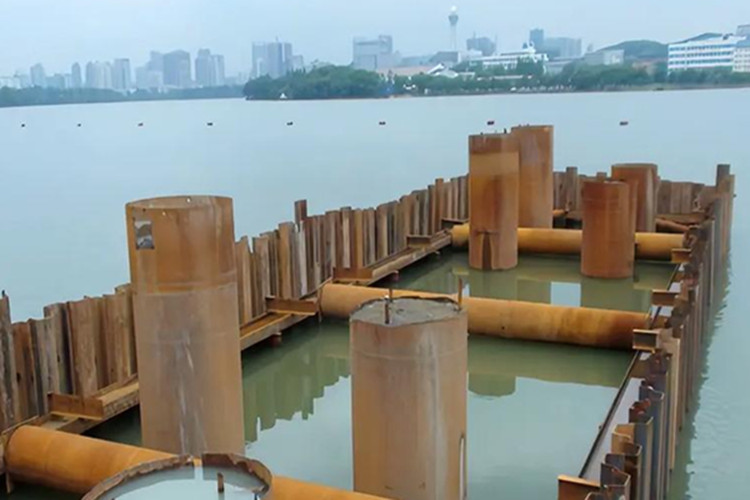
Retaining walls to intercept water can be constructed using steel sheet piles, reinforced concrete pile rows, underground diaphragm walls, fixed-jet pile curtain walls, rotary jet piles, and deep mixing piles. These methods should be determined in the steel sheet pile construction organization design based on topography, hydrogeological data, and construction methods. When artificially lowering the groundwater level, water collection wells or light well point dewatering should be selected according to the depth and scale of excavation. The number and form of the well point layout should be determined based on the permeability coefficient of the aquifer and the amount of water gushing out, and equipped with corresponding pumping equipment.
