- tyler@shipplate.com
- +86 15603721115
What is a double-row steel sheet pile cofferdam?
Although double-row steel sheet pile cofferdams are widely used, their detailed design currently relies primarily on semi-empirical and semi-theoretical calculation methods. Double-row steel sheet pile cofferdams are used as gravity cantilever retaining structures to calculate overall anti-slip stability and anti-overturning performance. This calculation method can meet general engineering needs, but it is difficult to accurately predict the displacement and deformation of the cofferdam during construction. This means that structural reliability analysis has significant limitations.
Why was a double-row steel sheet pile cofferdam chosen for the Yangguantun Dam project?
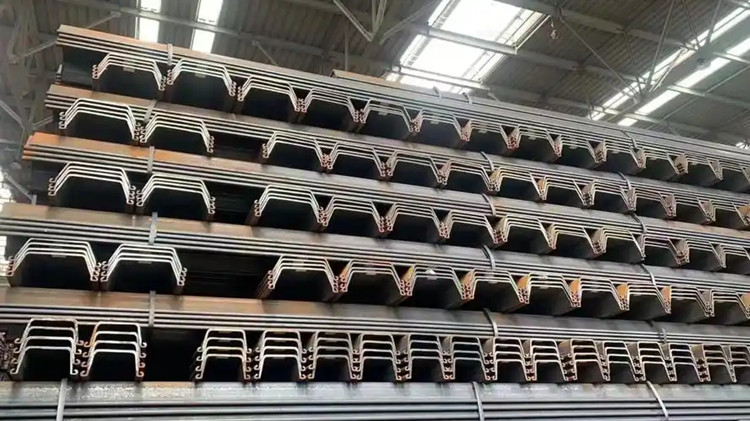
The Yangguantun Dam is a key component of the first phase of the South-to-North Water Diversion Project (East Route). The project's primary mission is to control and manage water resources in the South Four Lakes and provide navigational support. Specifically, the project is designed for a free discharge of 156 m³/s, with a navigation standard of VIIa (Class 3). The gate is 130 meters from the air inlet, and the gate chamber has two openings with clear widths of 8 and 12 meters. The Yangguantun Dam is located at the entrance of the Yangguantun River to the Nansi Lakes, where the waterway is narrow. The project's strategic location, at the junction of Shandong and Jiangsu, makes the construction area vulnerable to impacts. Furthermore, the project's generally low-lying terrain makes excavation and embankment construction nearby difficult. Due to site and land acquisition constraints, a cantilever, small-span, double-row steel sheet pile cofferdam was employed. The site's strata fall within the Huaibei stratigraphic zone of the North China Stratigraphic Area. This layer of soil is primarily composed of silty loam and medium-coarse sand. Furthermore, sand mining is widespread in the region, leaving few alternative construction options. Before construction, a detailed geological survey of the gate site was conducted. The foundations of the main buildings in this area are located in the second layer of clay, with an ultimate bearing capacity of 160 kPa, making it a good bearing layer for construction. However, during the geological survey, holes were discovered in the third layer of silty clay and the eighth layer of medium-coarse sand. Analysis determined that these holes were caused by sand mining. The large number of holes complicates the geological conditions for the project. The soil structure is damaged, and mechanical properties are far below the standards indicated by the uneven strength of the soil. The Yangguantun River is narrow, with a width of only 40 meters at the project site. Furthermore, the river needed to meet navigation requirements during the construction period, making a large-span double-row steel sheet pile cofferdam unsuitable. After comprehensive consideration of various factors, a small-span cantilever double-row steel sheet pile cofferdam was adopted. In this solution, the distance between the two rows of steel sheet piles is 6 meters, and the spaces between the piles are filled with soil. The steel sheet piles used in this project are WRUL3-575 Larsen steel sheet piles from Nanjing Wanhui Steel Sheet Pile Co., Ltd. These sheet piles are 58 cm wide, 36 cm high, and 1 cm thick. Furthermore, the piles weigh 78 grams per meter. Exploration results between geological drill rigs YG7 and YG11 (42 m long) revealed not only sand mining holes in the foundation but also black cracks above the bottom elevation of 26.5 m. Stability calculations indicated that the anti-slip and anti-tilt safety factor for the steel sheet piles in this section did not meet design requirements. This is due to the relatively short insertion depth of the steel sheet piles. At the same time, the double-row steel sheet pile cofferdam better demonstrates the flexible structural characteristics of the gravity-filled mass. Under the complex geological conditions of this project, deformation is often more severe, so the most effective way to address this issue is to increase the overall structural rigidity. After repeated discussions, 15-meter-long steel sheet piles were used in this section, with the double-row piles spaced 6 meters apart. Cast-in-place piles were installed between the double-row steel sheet piles, with their centers located on the centerline of the cofferdam. The piles were 30 meters long, 1.2 meters in diameter, and spaced 3 meters apart. Abutments were installed at the tops of the piles, and connecting beams were installed between the abutments to increase the overall rigidity of the piles. The channel steel was spaced 1 meter apart and evenly connected to the connecting beams. Drawing on the experience of this project, detailed research was conducted on the construction techniques of small-span double-row steel sheet pile cofferdams in narrow and complex geological conditions. Despite the narrow river channel, limited construction time, and complex geological conditions, the project successfully met the complex requirements of traffic and construction safety technology. The successful implementation of the steel sheet pile cofferdam at the Yangguantun Dam Project laid the foundation for the on-schedule completion of the main project, achieving excellent economic and social benefits. In addition, it also provides a lot of valuable information for similar engineering design and construction.
