- tyler@shipplate.com
- +86 15603721115
Steel sheet piles demonstrate exceptional adaptability in construction engineering. Thanks to their high strength, excellent watertightness, and ease of installation, they are widely used across a variety of complex construction environments and geological conditions. Their adaptability is primarily reflected in the following dimensions:
1. Diverse Application Scenarios
1) Urban and Underground Space Development: When excavating for basements, underground parking lots, or tunnel entrances in densely populated urban areas, steel sheet piles allow for vertical excavation without occupying excessive valuable space. Because the installation process—particularly when using static pressing techniques—generates minimal vibration, it effectively protects the existing foundations of adjacent buildings.
2) Hydraulic and Marine Engineering: Steel sheet piles are ideal materials for constructing quay walls, port facilities, ship locks, pumping stations, and flood embankments. They can penetrate water bodies to form continuous, secure retaining walls in high-water and tidal zones, preventing seawater infiltration and maintaining soil integrity.
3) Bridge and Road Engineering: In time-sensitive road widening projects, steel sheet piles serve as retaining walls for embankments, eliminating the need for large-scale earth excavation. In bridge construction, they are frequently used for cofferdams atop caissons or as abutment foundations, enabling rapid construction.
4) Environmental Protection and Containment: For contaminated land, sealed steel sheet piles combined with specialized sealants create a barrier with extremely low permeability, effectively isolating and sequestering hazardous substances.
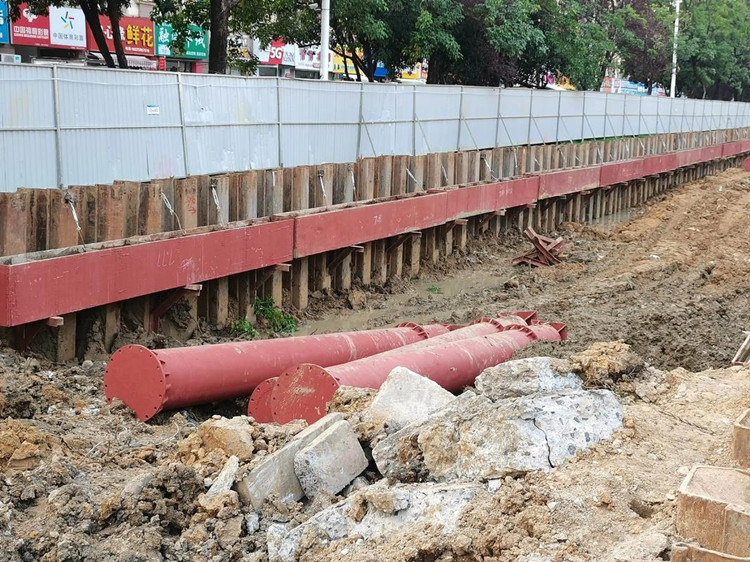
2. Adaptation to Specific Geological Conditions
1) Soft Soil Foundations and High Groundwater Levels: Steel sheet piles are highly suitable for areas with cohesive soils (such as soft clay) and high groundwater levels. They are lightweight yet strong and exert low installation stress; furthermore, their interlocking structure effectively blocks approximately 95% of groundwater infiltration, providing excellent water cutoff and settlement prevention capabilities.
2) Deep Foundation Excavation: When excavation depths exceed 6 meters, the cost of traditional temporary shoring becomes prohibitive. In contrast, steel sheet piles can be driven to depths of up to 18 meters without intermediate support and can withstand immense lateral earth pressure, significantly reducing shoring costs. 3) Challenges and limitations associated with specific geological conditions: Despite their broad adaptability, these piles face challenges in certain extreme geological settings. For instance, in strata with developed karst features, measures must be taken to prevent issues such as poor vertical alignment and leakage caused by the piling process; in sandy strata, it is necessary to guard against running sand phenomena triggered by tilting or deformation; and in hard strata containing large boulders, direct driving is difficult.
3. Diverse structural and profile options
To meet varying load requirements and environmental conditions, steel sheet piles are available in a wide range of cross-sectional profiles, such as U-type, Z-type, and straight-web types. Among these, Z-type piles—characterized by a high moment of inertia and superior flexural rigidity—are frequently used in high-load projects like deep-water port construction. In contrast, U-type piles are easier to manufacture and are better suited for lighter-duty applications, such as flood barriers subject to moderate loads. Furthermore, these piles can be assembled into circular or diaphragm-style cofferdams to accommodate the specific spatial requirements of construction sites in various aquatic environments.
