- tyler@shipplate.com
- +86 15603721115
The depth of steel sheet piles depends on much more than just their length. Geological conditions, installation methods, pile type, and wall design all affect the depth to which sheet piles can be driven safely and effectively.
For engineers and site managers, understanding these limitations helps in early design planning and avoids unexpected obstacles after piling begins.
1. Typical Depth of Steel Sheet Pile
Most sheet piles used in civil and marine engineering are driven to depths between 6 and 18 meters, but the specific depth can vary considerably depending on the purpose of the wall and underground conditions.
The table below outlines common pile depths and applications:
* Project Type Typical Depth Range (meters) Common Pile Type Installation Method
1) Shallow Excavation or Trenching 3–6 Trench Plate/U-Type Vibratory or Driven
2) Basements and Retaining Walls 6–12 Z-Type/U-Type Vibratory, Driven, or Impact
3) Flood Control and Riverbanks 8–15 Z-Type Vibratory or Silent Driven
4) Marine or Dock Wall Structures 12–25+ Z-Type/Tube (Composite Wall) Impact or Pre-drilled, Driven
5) Heavy Infrastructure or Offshore 20–35+ Tubular/Box Section Impact or Rotary Boring
6) These figures are not fixed limits, but rather practical ranges commonly seen in various UK projects. Some marine or port structures require piles longer than 30 meters, while small retaining walls may only require a depth of 4–5 meters. The type of pile also affects its depth.
2. What factors determine the depth of sheet piles? The depth is influenced by a combination of design and installation factors. Key factors include:
1) Foundation resistance and soil type—Dense clay, gravel, or rock formations can lead to early drilling failures, eliminating the need for pre-drilling or hydraulic pressurization.
2) Installation method—Vibratory hammers and impact hammers achieve different penetration depths depending on the vibration energy and pile stiffness.
3) Wall design and load—Deeper walls or walls subjected to higher lateral loads require greater embedment depths to maintain stability.
4) Sheet pile type and thickness—Z-type and tubular sheets have greater bending strength than lightweight trench steel sheet piles, allowing for deeper installations.
5) Water pressure and permeability—Marine or flood control projects require deeper toes to control leakage and hydraulic uplift.
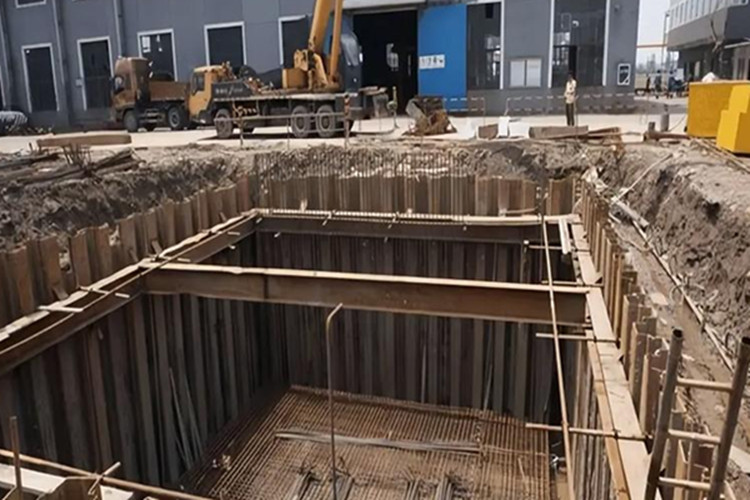
3. How deep can Z-type sheet piles be driven?
Z-type piles are designed with strength and stiffness in mind, allowing for considerable depths when site conditions permit.
In hard clay or dense sand, Z-type steel sheet piles can typically be driven to depths of 15-18 meters using vibratory or silent pressing methods. Deeper installations are possible with the aid of pre-drilling or impact-assisted methods, particularly in marine or infrastructure projects.
Due to the interlocking structure at the outer edges of Z-type piles, they exhibit excellent bending resistance, meaning that walls require slightly less embedment depth to achieve stability compared to lighter profiles.
For detailed information on different sizes of sheet piles, please refer to our steel sheet pile supply page.
4. How deep can U-type sheet piles be driven?
Under typical conditions in the UK, U-type piles are typically driven to depths of 8-12 meters. They are well-suited for temporary works, cofferdams, and medium-depth excavations.
Their symmetrical shape facilitates installation and extraction, but their bending capacity is slightly lower than that of Z-type piles, which may limit the actual depth in harder ground or under higher loads.
5. Can sheet piles be driven into rock?
Sheet piles can be driven close to rock or into rock—but not necessarily through it.
If the bedrock is shallow or irregular, piles are typically driven until they cannot be driven any further, then reinforced using the following techniques:
Pre-drilling or pre-augerring to weaken the rock layer directly above the bedrock.
Using reinforced toe shoes or driving shoes for impact driving.
Using rotary drilling or core drilling to embed the pile into the rock mass.
In this case, the design goal is not to penetrate the rock, but to achieve a firm embedment with it.
If hard rock layers are expected, drilling and ground data must be carefully reviewed during the design process.
6. How to increase sheet pile penetration depth?
If the pile foundation fails to reach the target depth, the following proven methods can be used to help it continue penetrating:
1) Pre-drilling—loosening dense or mixed ground before vehicles drive in.
2) Water-assisted pressing—reducing skin friction during installation.
3) Changing the drive equipment—using a higher-energy impact hammer or a variable-frequency vibratory hammer. 4) Toe Modification – Adding or reinforcing the toe cap.
5) Ground Replacement or Guided Drilling – Removing local obstructions.
These methods can typically achieve the required depth without affecting the alignment or interlocking integrity of the piles.
7. How is the required depth determined?
The pile tip elevation is calculated by the engineer based on the following factors:
1) The remaining excavation depth or water level
2) Active and passive earth pressures acting on the wall
3) Soil strength parameters and groundwater level
4) Safety factor to prevent slippage or rotation
For temporary works, the burial depth is typically 0.6 to 1.0 times the remaining height. For permanent or marine structures, the burial depth may exceed 1.2 times the remaining height, depending on the load and water pressure.
Designers also consider long-term corrosion allowances, meaning that structural sections may be slightly larger to maintain their long-term performance.
8. What happens if sheet piles do not reach the design depth?
It is not uncommon for construction to be refused before the design depth, which may be due to unexpected obstructions or denser rock formations. When this occurs, the website and design team should:
1) Verify the actual geological conditions against the drilling data.
2) Assess whether the achieved depth still meets the design embedment requirements.
3) If necessary, try pre-drilling, re-drilling, or using impact-assisted devices.
4) Never shorten the pile foundation without project approval.
If the depth still cannot be achieved, it may be necessary to reanalyze the wall or adjust the design—for example, increasing the pile cross-section size or adding anchoring devices.
Key Takeaways
There is no uniform limit to the depth of steel sheet piles; it depends only on geological conditions and design requirements. Depths exceeding 30 meters are achievable with appropriate pile type, construction methods, and preparation, while smaller civil engineering projects may only require 5-10 meters.
The key is early geological investigation, proper selection of pile foundations, and the use of flexible installation methods.
